Showing posts with label Maths of the day. Show all posts

Friday, January 05, 2018

Maths of the Day - December


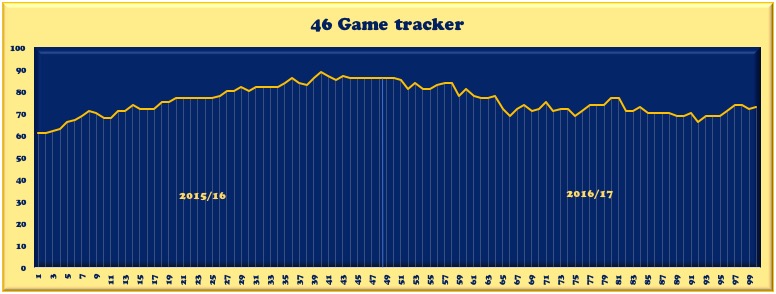
The Clotet era has been characterised by a rollercoaster of highs and lows. You can see it in the short term form graph. What is perhaps notable is that the peaks have got smaller, implying that the results, though not without their moments, have got progressively worse as the season has progressed.

Inevitably, this has had an effect on the long term form; the number of points in the 46 game to the end of December saw us reach a low of 71, one point ahead of Appleton's worse League 1 total of 70 but still only one point behind where we were at the end of last season. 


That said, we remain pretty much toe-to-toe with last year's run rate. As I mentioned last month, though, Clotet has a challenge on his hands in the coming months; last year our form picked up significantly after Christmas, so we're going to need some stellar results in the coming weeks if we want to keep up.


It's not the fixture mix that's causing the issue - comparing like-for-like results, for the first time last year's results have crept ahead of this years. Had we played exactly the same teams in the same order, then we'd have one less point than last year.


And finally, another take - some have picked up on Michael Appleton's first season in charge. We can debate whether Appleton or Clotet had the harder task - Appleton was rebuilding a squad, as was Clotet, but Clotet had, arguably, the more stable platform. He also had the harder task - building a League 1 rather than League 2 team. Looking purely objectively, however, after 25 games Clotet is three points ahead of Appleton's first 25. 


So what might this tell us; overall, under Clotet we have still had a steady season and those calling for his head are probably being a bit premature. That said, his star does appear to have faded. January offers an opportunity to bring in reinforcements and, without the distraction of the cup, a slightly more manageable post-Christmas programme in comparison to previous years. It's important he capitalises on these opportunities. 

Friday, November 10, 2017

Maths of the Day - October

Five Game Form

It's fair to say, to date, the Pep Clotet era is characterised by highs and lows. Following three defeats last month, we then nailed three wins, followed by two draws, only the defeat to Fleetwood spoiled what would have been a very pleasing sequence for those who like symmetry. The impact is that we recovered during the month to a much more normal short term form.


46 Game Tracker

Given our propensity for short-term highs and lows, it's more important to look at the bigger picture. So although the ride has been a bit of a rollercoaster, we ended the month in 2 points ahead of where we were at the end of September, suggesting some progress.


Run Rate

This is reinforced when you look at the run rate. October was always an opportunity to pull ahead of last year's total given we had pretty average form. The draws against Rotherham and Charlton meant we didn't pull as far ahead as we might have done, but we still sit 4 points better off than last year.


Like for Like

A new one - a tracker of our points total against the same teams last year. As such, it discounts the games against Portsmouth, Blackpool and Rotherham, giving us a more precise indication of our progress relative to others. As the graph shows, we are 2 points better off than we were against the teams we've played this season. So, although the margins are fairly narrow, we're still ahead of last year, and that's difficult to argue against.


Thursday, October 05, 2017

Maths of the Day - September

You might want to look at this through your fingers; no three game losing streak is ever going to look good when you pick through the stats. Or does it? Not in the short term, but longer term, things might not be so bleak. It's Maths of the Day for September.

Five game form


It probably won't come as much of a shock to anyone that our form in September has plummeted from an all-time high of 15 points in five games to just four points from a possible 15. Only Michael Appleton's first weeks in charge were worse. Even the win over Peterborough didn't allow a bounce back, just replacing the 3 points won against Gillingham. 

46 game tracker


Looking longer term, however, shows a little kick-up from the Peterborough win. Michael Appleton had a pretty good September last year with two wins and two draws, so the three defeats against Blackpool, Walsall and Bury this year did take their toll. Those claiming terminal decline, though, might be being a bit premature; we finished last season on 72 points, and in the 46 games to Peterborough we picked up exactly the same number. The dip in form isn't comfortable, but what it's actually done is take us to where we were on the last day of last season, when confidence and optimism was high. Just shows how easily distracted we can be by short term form.

Run rate


To re-inforce the point, looking at the run-rate, we finish September on exactly the same number of points we finished with this time last year. Not as good as our promotion season, not as bad as Michael Appleton's first year; bang in the middle. What's more, if you cast forward you'll see a flatline from last season (6 points out of a possible 18). Even moderate form during October should see us improving on last year. If we consider that we finished the season just 4 points short of the play-offs, it shows that despite everything, we are still in a good position.

Thursday, September 14, 2017

Maths of the Day - August 2017

It's Maths of the Day, in which we use statistics to prove things that are obvious with the false reassurances of numbers. We only look at league games, because cup games skew the stats. So here are the stats up to the MK Dons game, which technically takes us into September, but who's counting?

Five game form


Five game form shows our rolling five game points total, a demonstration of changes in our short term form. With a change of manager and it being so early in the season, everything needs to be taken with a pinch of salt. But what is obviously notable is that the two wins at the start of the season coupled with the three at the end of last means we delivered our first maximum 15 points since before Michael Appleton's arrival in 2014. Obviously, and predictably, that couldn't be sustained with the defeat to Scunthorpe and draws with Shrewsbury and MK Dons. But if you look at our run of form during Michael Appleton's first season and that of most of last season, we are in a very comfortable position.

46 game form


Looking longer term, at a rolling 46 game, whole season, programme. Again, still very early days, but the graph shows that as we should probably have expected, last season saw a gentle but far from concerning slip in terms of the points we'd accumulated by the end of our promotion season. What the little tick at the end of the graph shows, however, is a recovery in the back-end of last year which was sustained for the start of this. 

Run rate


Anyone worrying about our start just has to look at this, we're comfortably ahead of where we were this time last year. Naturally last season Michael Appleton had some capital in his locker and there was the novelty of League 1, so nobody was worrying about the start we made a year ago. Clotet has neither of these, but his opening month, despite all the disruption during the summer and during August he has delivered a very solid start.

SaveSave

Wednesday, March 09, 2016

Maths of the Day - February

February always looked pretty pivotal, we opened the month with a defeat (but victory) over Millwall taking us to Wembley, then the rapid fire fixtures against Northampton, Accrington and Wimbledon - all promotion and play-off contenders - plus Exeter, Wimbledon, Morecambe away from home.

The squad had been pummelled physically and mentally during January and then were faced with an intense fixture programme. How did we hold up?

Appletonometer

It wasn’t all plain sailing; frustrating home form and, for the first time this season, two consecutive defeats. That said, the Appletonometer actually finished the month on a high. In the 46 games to the Wimbledon win accumulated 84 points. We flatlined for most of the month, which reflects that our form was almost identical to this time last year, but the kick-up post-Wimbledon means we’re in a better position than we’ve ever been under Michael Appleton.


Five Game Form

Unsurprisingly, however, short term form has taken a dip since Christmas.The two defeats against Northampton and Accrington saw our form drop to below what’s needed for even the play-offs for the first time since last season. To some extent, our current position is reliant on strong early season form.


Run rate

And the big picture? We’re still comfortably on track for promotion. Or as comfortable as it's possible to be in a promotion race. The thing with promotion, and something we're not used to, is that you have to keep accumulating points because that's exactly what everyone around you is doing. In a normal season we’d be competing for the title, but Northampton aren’t normal team this year. Still, with March looking like a much more straight forward month, we do look like we're in a strong position.


Sunday, February 07, 2016

Maths of the Day - January

Appletonometer


Because we only deal with league games in Maths of the Day, the January figures only cover three games; Notts County, Bristol Rovers and Portsmouth - two epic away wins and a lacklustre defeat at the end of a monumental week. 

Still, the rolling 46 game graph - the Appletonometer - continues to show an upward trend and actually tipped over the 80 point mark for the first time. Put that in perspective - if Oxford United last season were in a league with Oxford United who has played the last year, there would be 20 points difference between the two teams. If that shows anything, it's how much the club has been transformed.

Five game form


Our current form is difficult to assess. If you count the cup games we've lost three in four and the last three at home. But, it's not really fair to assess our form when we're playing teams in divisions above us. 

So, discounting cup games, our form has actually spiked upwards to a level which would typically win you the title. The big question is, now the cup games are out the way, can we sustain it?

Run rate

Overall, we're still sitting right on the run rate that would typically win you the title. I say typically, because Northampton are on a run of form which blows all this out of the water. Nine wins in ten is, like Leicester challenging for the title, something you can't account for when it comes to predicting the future.

All is not lost in that respect, however, if we win our game in hand and the game against Northampton on the 16th, we'll be four points behind. One of the things about extraordinary form is that at some point things will return to being more ordinary; if the Cobblers do wobble, then we're in a good position to pounce.


Wednesday, January 06, 2016

Maths of the Day - December

How December looked in graphs...

Appletonometer

Earlier in the season, the Appletonometer - the accumulation of points on a rolling 46 game basis benefited from some 'free points'. The start to last season was a disaster, anything we did at the start of this was going to be an improvement. 

We now appear to be at a bit of a cruising height holding around at 77 points for the last few weeks. After the Yeovil game that picked up to 78, which is both an improvement on last month and an all-time high, but only just.


Five game form

The reason is our short-term form, the Wycombe defeat hurt us, but when you're picking up more than 10 points out of every 15, the loss of three is always going to have an effect. We ended the month with form of 8 points from the last 5 games. A drop, no doubt, but not the worst. Also, it's not time to hit the panic button, even our moderate form is an improvement on much of last season.


Run rate

To illustrate the need not to panic, we are bang on the money in terms of winning the title. When the objective is promotion, it shows we have quite a bit in reserve to handle this period. There are two issues related to that; the first is if the division over-performs and actually the targets are too low. This is something that's quite possible, but that we can't control. The other issue is buckling under pressure if we were to drop below third. The season won't settle until the FA Cup and JPT are settled, but I wouldn't be surprised to see our form trundle along in this fashion for a few weeks yet and that could see us drop into the play-off zone.


Saturday, December 12, 2015

Maths of the Day - November

Appletonometer


It doesn’t look much on the graph, but our good form in November – three wins, one draw - saw us hit another peak on the Appletonometer. In the 46 games up to the end of November we’ve picked up 77 points, which is comfortably play-off form. That’s an improvement of 2 points on the end of October, a whopping 15 ahead of the end of last season. By comparison, Chris Wilder’s best ever points haul over 46 games was 78; which only came a couple of months before he left us. He’s not quite there yet, but Michael Appleton has achieved 20 games what Chris Wilder took 109 to achieve.

Five game form


It’s no surprise then, that our short term form was excellent in November. In the five games up to and including Hartlepool, we took 13 points out of fifteen, the second time that we’ve done that this season. It’s now been the best part of two months since we dropped below title form and six since we achieved less than play-off form. One of the reasons for starting Maths of the Day was to work out whether short term gains we genuine improvements or not. There appears to be no fluke in this form.

Run rate


Top of the table, so it’s no surprise to see us showing title form. We’re two points ahead of where we really need to be to win the title, five ahead of an automatic position and nine ahead of the play-offs. That’s a healthy buffer to have with just less than half the season gone.

Over-performing/under-performing


At the end of November, we shared the lead on points with Northampton and Plymouth, so if we’re demonstrating title form, then so must they. Of course, only one can win the title, meaning either this is an exceptional year, or someone is going to fall. You might reasonably argue that Northampton are probably most vulnerable; we know a lot about Christ Wilder’s ability to create short term spikes in performance, but his struggles to sustain it. I think he was the perfect man to have in place during their recent crises. And it’s their crises that give us the second reason to believe they may fall away; few clubs solve their problems overnight whether it’s the stress of what they’ve gone through or legacy issues relating to finance, you suspect they’ll appear at some point. Not that this should worry Cobblers fans, they’re probably happy to still have a club to support.

The only team who might threaten the automatic positions, based on current form, are Accrington Stanley. Stanley are, by all accounts, the smallest team in the Football League, which implies they are seriously over-performing.

Should everything go to form, then, there are three remaining play-off spots to go for and four teams currently performing at or above the level needed to achieve it. Portsmouth and Orient both threatened to be part of the elite, but both seem to have contrived to find a new crisis to occupy their time. None-the-less, you suspect having got off to a decent start, they should be able to see it through to at least the play-offs this year.

Which just gives us one more slot to fill – Carlisle and Mansfield are surprise packages given that they’ve suffered near-relegation in recent years. It’s a toss-up between the two, ultimately,  Carlisle feel like a club that should be more successful than they are, but Adam Murray seems to have built a solid team – including Matt Green – with which to threaten.

Which is to say that all things being equal, automatic promotion is absolutely within our grasp and the title a real possibility.

Sunday, November 22, 2015

Maths of the Day - October

Appletonometer

The Appletonometer, which measures the manager's rolling 46 game points total meandered away throughout October before ending the month on 71 points, exactly where he was at the end of last month. The defeat to Barnet and draw with Orient didn't help, but otherwise, the month was a good one. It's just that October last year was also pretty good by the low standards we came to expect.


Five game form

Five game form illustrates the month's performances much better, while the long term trend flatlined, in the short term we're still better than we've seen since Appleton's arrival last year. Even with the dropped points against Orient and Barnet, in the short term we're still showing title form.

Run rate

In so many ways, the most important measure it how we're doing against our target of promotion. And the answer is that we're bang on track, if not a little ahead. We closed the month with a points total that would see us winning the title in May if we kept it up. And if you need any more assurance we're on the right track, which you don't, look at the droopy grey line at the bottom. That's where we were last year.


The best of times, the worst of times

When Tim Walker asked me last month for a reverse polynomial of David Kemp, I thought he was inadvertently referring to a practice only found on the dark web. It got me thinking; one thing about the grinding mundanity of Oxford United’s performance over the years is that both success and failure, when they come, are in stark relief to everything around it.

The comically awful 2000/2001 season represents, without question, our worst ever season performance-wise. It wasn’t just Kemp, of course; Denis Smith, Mike Ford and somewhere along the line Joe Kinnear got involved in the debacle.

We won seven games, conceded 100 goals and ended with a goal difference of -47. We played with over 40 players, including Dean Whitehead and current Swansea manager Gary Monk. Incidentally, we scored the same number of goals as Wigan in 6th but conceded 20 goals more than any other team. The top two teams; Millwall and Rotherham, conceded less goals than us combined. And if you thought that was bad; goalkeeper Richard Knight - one of five goalkeepers that season - without irony, was awarded player of the season.

But, when was the peak? That’s easy too; we’ve only won two titles in my lifetime; 1983/84 and 1984/85. I was about 12 and thought this was how life was always going to be. Of those titles, the first saw us amass 95 points, 10 more than the following season. And if you say that we played less games in 84-85, then you're right, but we still had a better points average by 0.04. I've checked.

Although we’d have our moment in the sun at Wembley, as a season of performances, 1983/84 was the best it ever was. Incidentally, in those two promotion seasons we lost just two games at home. That's Oxford United - from Aldo to Anthrobus.

But then, this is Maths of the Day. How does that look in some sexy graphs?


Well, pretty obviously, the run rate in 83-84 was a steep incline while 00-01 limped along all year to a paltry 27 points. By comparison, in 83-84 we passed that mark after 14 games. This season we're getting to that point, so at least this isn't going to be the worst season ever. 

What is pretty interesting is just how closely the record run rate aligns with this season. Admittedly, it coincides with the only slump we suffered that year, and there's a long way to go, but better to be closer to the red.


The five-game form book looks as you'd expect. Basically the best form we ever displayed during 00-01 was barely better than the worst form we shows in the promotion year. Again, this season chugs alongside the right line. There is a slump in all three seasons around the 10 game mark. From our perspective it is worth noting the two or three slumps we suffered even when accumulating record points. One in particular, early in the season, was close to relegation form. That, perhaps, reminds us that we will, probably, suffer the worst of times, even at the best of times. The challenge is toughing it out and bouncing back, in the long-term, as long as the goal is reached, the short term blips will be long forgotten.

Thursday, October 08, 2015

Maths of the Day - September

Appletonometer


A tricky month in which the Appletonometer - the rolling accumulation of 46 games - took an alarming dip. It didn't help that in September last year we did start to pick up a small number of points - losing one game (but only winning one as well). The bookend victories against Bristol Rovers and York City saw two peaks. Despite the dip, Appleton ends the month higher than he did at the end of August.

Five game form


Unsurprisingly the rolling five game form took a dramatic dip, but in the context of Appleton's entire tenure, it's hardly time to hit the panic button. Those who screamed that we were showing relegation form were wrong. Very wrong.

Run rate


Although the run rate - the accumulation of points in a season compared to a straight line title, promotion and play-off trajectory - looked like it was heading off the play-off radar, the win against York saw it spike back upwards. Form remains comfortably in the play-off zone and heading towards automatic promotion. Those with short memories might like to have a look at the run rate from this time last year (in grey). After 10 games we had just limped to the 7 point mark and any hope of promotion was already dead. You don't know you're born you don't.

The Wilder comparison

Last month someone asked me what things would look like if you extrapolated back a few more years. In a sense, that's of limited value because it would span a number of managers, a couple of owners, and countless players, of course. You can judge long term performance from your league position. Maths of the Day is looking at shorter-term trends and performance against a promotion objective.


However, there may be some value in looking at Chris Wilder's performance against similar criteria as a benchmark. It's still comparing apples with pairs, not least because Wilder was in charge for over three years in the Football League (there's no point in looking at the Conference). The results, I think, are quite interesting.

Most notable is the 46-game Wilderometer, which spans 110+ games as opposed to Appleton's 10. At no point in that period did we trouble the automatic promotion places. So even though there were times when we topped the table, it was no more than a short term thing rather than the culmination of long term development. Interestingly, Wilder's performances generally improved towards the end of his tenure after quite a long period where we were quite a way off the pace.


Wilder was a short-term form man. Anyone who watched us over that period would recognise that. The range is remarkable; we had a five game stretch where we took no points and one where we took maximum points. On nearly 20 occasions we were in short term title form, but on at least as many occasions we were in dire relegation form. We just seemed incapable of stringing together any long-term form. This probably why Wilder became such a Marmite manager; there were those to suckled off the thrill of big results, and those who couldn't handle the massive come-downs that typically came afterwards.

Does that characterise Wilder's time at the club? Yes, I think so. Does it show what Appleton has to conjour up to move us forward? Indeed. 

Tuesday, September 01, 2015

Maths of the Day - August

Appletonometer


The Appletonmeter is the rolling accumulation of points over 46 league games. That is, a full season. We ended last season with 61 points, so every game we play this season, drops one from the start of last. For example, our draw against Crawley at the start of the month means our opening day defeat to Burton last year no longer counts, as a result we gain a point. It judges Appleton’s overall performance by discounting most variances like time of year, home and away bias and seasonal factors. Cup games aren't included because one season we could have drawn Dagenham at home the next Chelsea away; that would skew the results.

The good news is that the Appletonometer has increased from 61 points to 69 in the year to the end of August. The less good news is that it couldn’t have been worse; we didn’t gain a single point at the start of last season until the draw against Dagenham at the end of August. Our first win wasn't until mid-September.

With such a handicap, it’s no surprise that we’ve yet to string together a 46 game sequence which would take us into the play-offs (70 points), but we're close. Still, as far as the Appletonometer goes, his star is in the ascendency.

Five game form


Five game form calculates our accumulated points over a rolling five game sequence since Appleton came to power. It’s a better indication of where we’re at today, rather than being handicapped by the poverty of our form a year ago.

The graph shows, unsurprisingly, that we've been in our best spell of form since Appleton’s arrival. For a period, it would have been good enough for the title. It dipped a little as the wins from last year were replaced by draws from this, but with the win over Yeovil, we end the month in automatic promotion form.


Run rate


The run rate calculates the accumulation of points over the season and then benchmarks it against a typical straight-line promotion trajectory. It's useful because it discounts short-term form. For example, Leyton Orient have maximum points so far, but it would be a miracle if they did that all season. This works on the basis that 87 points gets you the title, 81 points gets promotion and 70 gets you into the play-offs. We don’t factor in relegation points, at least not yet.

So early in the season, the differences between the title, promotion and the play-offs is small, so individual results can have a significant effect. After a slow-ish start, the win over Notts County propelled us into the play-off zone, but we dipped back out after the draw with Mansfield. Yeovil took us into the zone of automatic promotion, which is a very good place to be, if we can keep it up.