Showing posts with label AFC Wimbledon. Show all posts
Sunday, September 30, 2018
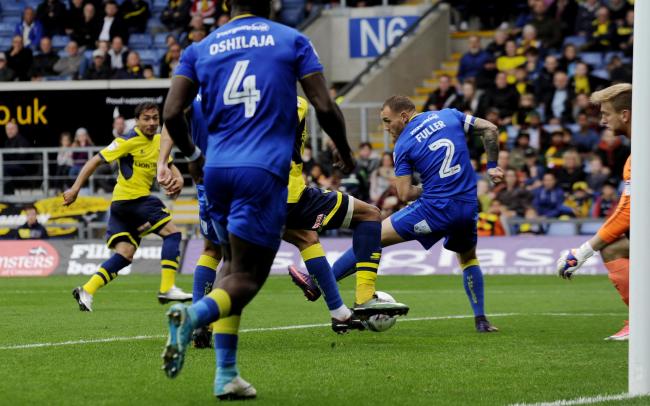
The wrap - Wimbledon 2 Oxford United 1
Football clubs have funny structures; at their most important point - the interface between the machine that funds the club and the machine that delivers the benefit is one person; the manager. If it were a car, it would be like having a single screw holding the engine to the chassis.
Clubs are beginning to wise up to the idea that they have this single point of failure. A club like Watford, for example, have changed their manager almost annually in recent years, while the machine the sits behind them has remained fairly stable. Despite this apparent flux, they have progressed year on year.
Managers don't last very long; yes, owners are often hasty in their decision making and sometimes managers attain positions they are barely capable of leading on the basis of their connections or playing record. But, it's not always a simple question of competence.
Being a manager is a ridiculously stressful job and often its that, not their ability, which results in their departure. They're the aforementioned single point of failure, they have to explain everything to the media, they are in an occupation which has only 92 positions in the country of which no more than one or two are vacant at any one time. With the odds stacked against you; it's surprising that any manager is wholly rational and logical in the first place; if you applied logic to football management as a career choice, you wouldn't choose it in the first place.
Stress comes from being overwhelmed with the information you're expected to process. Sometimes there's too much, sometimes it makes no sense and you can't find the links and logic. The log-jam of unprocessed information causes your brain to go into overdrive trying to process it day and night, or sometimes shutting down and pretending its not happening.
Karl Robinson is stressed. Not because he's stone cold incompetent; what he achieved at MK Dons and Charlton both show he is capable of managing a football club to a degree of success. But, his current situation hasn't happened to him before. Injuries, performances that don't produce goals or results, an owner he struggles to communicate with, fans that don't trust him; all at the same time, one overlapping another like waves.
Even if he has been given assurances, there must be some part of him that knows his job is under threat. Add to this the knowledge that reputations are rapidly crushed in football; one failure and your reputation can drop like a stone. It's not just a question of proving your competence, it's also that your failures make you toxic from a PR perspective.
The signs are there - last week he skulked his way through his interview feeling sorry for himself, yesterday - after the defeat to Wimbledon - he was even less coherent. There was something about him doing his job by preparing the team in the middle section of the field, it was, he said, down to players to put the ball in the back of the net. The subtext was that it was them to blame, not him.
I think I know what he meant, when you're in front of goal, someone has to take a risk and shoot. But the idea that once the ball reaches the penalty box, the manager's job is done is clearly nonsense. Anyone who saw Liam Sercombe score 17 goals from midfield in 2015/16 - frequently following up missed opportunities - knows that you can increase the chances of scoring through a pre-defined way of playing.
If you add to this his decision to take the captaincy off Curtis Nelson or drop Cameron Norman because - as stated publicly - he's not playing well (not because Sam Long did well against Manchester City), suggests to me that he might be being honest and straight forward, but he's not thinking about how his actions might impact the players or the fans.
It's important to separate out Karl Robinson, the person, from any stresses he is currently experiencing. I don't believe he is an incompetent charlatan, who has managed to trick his way through his career. I do believe that he's struggling to process the problems he has and I question whether he will get the support or headspace to recover his rational side. And, for that reason, you have to question whether - for him and the club - the relationship is sustainable.
Monday, March 12, 2018
The wrap - Wimbledon 2 Oxford United 1
When does a transition become a debacle or a debacle become a transition?
Do you remember when Nick Merry turned up in his cowboy boots to install Jim Smith as manager and take us into the Conference?
Or when Darryl Eales took over and installed Michael Appleton as manager to lead us to lower-mid table in League 2, playing 42 players in the process?
With both takeovers, things got worse before they got better (Merry was a front for Ian Lenagan, who eventually funded our promotion back to the league), both involved managerial as well as ownership changes. One was at the end of the season, one was during the summer, and both brought significant levels of disruption.
Takeovers cause disruption, particularly in smaller clubs which don’t have a big corporate infrastructure with the ability to keep things stable. Just how much of this is avoidable is open to debate. But, whether it's at the end of the season, the start or in the middle, it inevitably causes a problem.
Perhaps the disruption could have been reduced by keeping Pep Clotet in position; but he was rapidly losing favour with the fans and Darryl Eales largely confirmed that his sacking was more complicated than simply a bad run of results.
The appointment of Clotet’s replacement has clearly been caught up in the transition from Eales to Tiger. For Tiger to sanction Eales’ preferred candidate – Craig Bellamy – would have been daft. Lining up a replacement without actually owning the club would have been similarly difficult. He would already be on the back foot had it gone wrong. Tiger needs to be comfortable with the appointment so that he can back his man - with words and money.
What is certain is that the club isn't moving forward until the management issue is resolved. Staff don't know whether they'll have jobs, players don't know whether they'll have contracts, everything is on hold. Football games are won and lost in the margins, which is why you have to play over 40 games to decide who is best. If we've lost a few percentage points from the disruption, then that's what is turning draws into defeats.
Inevitably, much will be forgiven once the new man is in place, with the exception of a few names - Graham Westley, Steve Evans - almost all new managers bring a sense of optimism and purpose, and I'm sure that this will be the case with us. In the short term, at least.
The delay is damaging to Tiger's credibility, something he may not be too worried about; rich people understandably tend to have a high degree of self-worth. But the problem comes in the summer when it's time to renew season tickets, if fans can't see a substantive move forward, they are more likely to hold back on renewals, particularly as it seems we have reached a ceiling price for watching Oxford in League 1, judging by the criticism received after last year's price rises.
Whether relegation is as inevitable as some fans seem to think is open to debate. It is far from certain that we'll avoid the drop. However, although there is a gap of 4 points between us and Fleetwood in 21st, there's 10 between us and 22nd. Assuming that three of the four slots are all but confirmed, in a mini-league table where we, in 16th, are top, the potential of going from top to bottom by the end of the season remains distant.
But, a win is what we need, of course, to settle the nerves and remind ourselves that we can do it. A manager coming in to instill a sense of direction will help that immeasurably.
Wednesday, October 11, 2017
The wrap - Oxford United 3 Wimbledon 0
There's a group of fans that sit behind me that I regularly tweet about; their analysis is endlessly unforgiving; if the ball goes into our half invariably one of them will groan 'Oh, here we go' suggesting the inevitability of us conceding. Any attack that breaks down is chastised for having 'no end product.'. Any goalscorer who hasn't found the net in the previous 20 consecutive games is labelled as 'having done nothing' for the club.
They were at it again on Saturday; some of our intricate, spectacular build-up play was viewed as 'all very well, but where was the shot?'. No thought is given to the fact that stringing passes together and hitting the back of the net is an exceedingly difficult thing to do. Nothing about using the ball to pull apart the opposition's shape and structure. No consideration, even, for the physical impossibilities of shooting with their back to goal, 30 yards from goal with two defenders jockying you out of play.
These are people who view a spectacular save to be lucky - 'Ooh, he only just got to that', and not the product of what Simon Eastwood had spends his entire week preparing for.
They're not alone; quite understandably someone like Richardinho enjoys cult status for his general demeanour. But our apparent return to form over the last week has coincided with us being able to play our dependable players in their most suited position.
James Henry gave a virtuoso performance, but not in a way that would have songs featuring his name cascading down the terraces. He understood when to keep things simple, when to pass, when to turn back, when to try something audacious. He pulled Wimbledon apart down the right flank creating chaos which goalscorers Xemi and Ricardinho benefited from.
John Mousinho looks increasingly comfortable in the middle of defence with Curtis Nelson, while up front Wes Thomas played with measured precision. It's an understated quality that has been absent in recent years. The systematic dismantling of Wimbledon, like those against Gillingham, Portsmouth and Peterborough, have been built on the stable influences of these new dependables, they may not thrill those sitting behind me, but they might just be thanking them in May.
Wednesday, January 25, 2017
Weekly wrap - AFC Wimbledon 2 Oxford United 1, Oxford United 4 Rochdale 0
January was always looking to be a tricky month. It’s always a bit of a challenge juggling the transfer window and a schedule disrupted by cup games. Last year, the stakes were higher with promotion on the cards, this year we were on the road for almost the whole month, apart from THAT game in THAT trophy and THAT doesn’t really count at all (or does it?).
We also went into the New Year on the back of a goal drought and apparently poor form, although this was a little overstated. If January’s road trip HAD gone wrong, then things could have looked rather bleak. Instead, we’ve seen three wins in four, four in five if you count THAT game, and we’ve scored 13 goals.
The blip was against Wimbledon which proved, if this needed proving, that we are not particularly good against more direct, robust teams. But otherwise, where has it all going right?
I’ve consumed most of the games via brief YouTube clips; each one seems to start with Marvin Johnson collecting the ball and running at the opposition’s defence. Johnson’s ever ascending stock has been key to the upturn in form. He’s like a high performance sports car, he’s so effortlessly powerful, he doesn’t look like he’s going quickly, but everything around him goes backwards.
Ryan Taylor is on his best run in the team, featuring in the last 14 games. This will have helped him settle into the system as well as build his fitness. As well as three goals himself, he’s helped 10 different players score in those 14 games, showing, I think, the value of a centre forward who can hold the ball, occupy defenders and bring others into the game.
Last year, January was like a big night out; epic fun with a crucifying hangover. Last year we won four of the first five games of the year, but only won one of the next six. It’s something we have to guard against.
The Newcastle FA Cup game is a free-hit; a bit like Swansea last year, they’ll play a second string and we’ll be up for it. If we don’t win, nobody will blink, if we do, then we’re getting to the interesting end of the competition.
Talking of interesting ends of competitions; the other curiosity is the EFL Trophy. With the Under-23 makeweights all gone the competition is gaining a different complexion. Yes, I understand the principles of the protests and the point has been well made. But ultimately, I’ve seen Oxford play at Wembley three times in 40 years. That’s a lot of time not seeing us play at Wembley. And life is very short. There is also the added incentive of finals against Luton, Wycombe or Coventry which would all make another grand day out. When does sticking to your principles just simply become pigheadedness?
Monday, October 10, 2016
Wimbledon wrap - Oxford United 1 AFC Wimbledon 3
In the same week that Donald Trump talked about grabbing women by the pussy, I heard someone using the word ‘awfulising’. If this isn’t the end of days, I don’t know what is.
Awfulising, apparently, is where you have a minor anxiety and your mind runs amok creating an entirely imaginary world of disaster.
There’s a bloke near me who habitually groans ‘oh, here we go’ every time the opposition go over the half way line. Plus, of course, there’s the common knee jerk reaction that fans have when one poor touch or pass turns a player into a lazy, hopeless waste of space.
It’s natural to awfulise in football; you only want one outcome and by-and-large that isn’t confirmed until the final whistle. But, sometimes it’s worth taking a step back; Michael Appleton’s selection against Wimbledon seemed to be based on taking an early initiative. Alex MacDonald is an impact player, he’ll never give up, but he struggles to maintain his all action game for 90 minutes. So, you have to decide at which end of the game you want him to have maximum impact, Kyle Hemming is similar. With both starting everything pointed towards going for an early knock-out.
What Michael Appleton didn’t seem to account for is that, after a ropey start to the season, Wimbledon seemed to have dusted off an old playbook from the 80s; they’ve gone physical.
New-Wimbledon are cast as a metrosexual hipster club; the romantics’ favourites. Culturally they’re the complete opposite of the Crazy Gang. So, it’s easy to think of them as a soft touch, and that’s what caught us out.
Chey Dunkley will not have a tougher afternoon all year; he’s usually a match for anyone in a physical contest, and apart from the goal he seemed to contain Elliot pretty well. But once Elliot had gone, he then had to deal with Tyrone Barnett.
It came as a bit of a shock to the referee who seemed to struggle to distinguish between physical but fair and physical and unfair. Early on, he was happy to book players for physical challenges, then having made a rod for his own back, he had to let rough challenges go just to keep things credible.
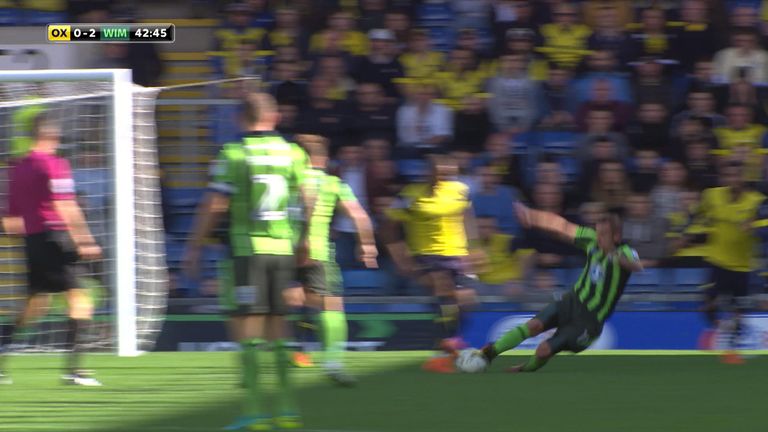
By the time it started to count, he was lost. It’s rare that a game pivots on a single decision. Generally, I think referees have much less influence over a game than managers would sometimes have you believe. But Dean Parrett’s sliding challenge on Wes Thomas just before the second goal defined the game.
So, let’s get to it; in the ground it looked a certain foul, but the ground level camera showing the referee’s view made it look like he got the ball. However, he was clearly overstretching and you can argue he was out of control by the time he put his challenge in. The camera from behind confirmed it, showing him off the ground and therefore out of control.
But then, so was John Lundstram in the challenge that got him sent off against Stevenage and banned for Wembley last year. We certainly didn’t think the Lundstram deserved his red, and as a principle, I don’t agree with trial by multiple TV angles in football. Therefore, my view is that it was probably a foul, but I can see why the referee allowed it to stand.
In addition to the goal that resulted, we were shell shocked, which was the root cause of conceding the third. And after that, it was all over. Had it been a foul, the outcome of the game would have been different.
So, ultimately we were tactically outmanoeuvred; we came to take charge and exploit Wimbledon’s supposed soft belly. In the end we were caught out and didn’t react properly. We will, I hope, learn from the experience; next time, rather than awfulising at a setback, maybe we need to grab the game by the pussy.
Wednesday, March 02, 2016
Wimbledon and York wraps
AFC Wimbledon 1 Oxford United 2
If in November you’d told Oxford fans we would head into games without Jake Wright, John Lundstram, Kemar Roofe and George Baldock, The Samaritans would have been launching one of those helplines they set up for teenage girls when boybands split up.
All good teams are built on a strong spine which, if damaged, can create real problems for a club’s aspirations. In 2009/10 we had a strong spine which shot us to the top of the Conference. In January Luke Foster was shipped out, Adam Murray succumbed to injury and James Constable’s goals dried up. Chris Wilder frantically tried to replace that spine with a series of speculative loan signings. The longer it went on, the more frantic the flailing became. Eventually Jake Wright overcame his early shakiness, Adam Chapman overcame his impending prison sentence and James Constable found his shooting boots. By that point the title was lost, but thankfully, we still had the play-offs.
The loss of Wright, Lundstram and Roofe over a couple of games and Michael Appleton could have been forgiven for struggling to replace them. But, in Dunkley, Ruffels and Bowery, we seem to have more than adequate cover. What is quite interesting about this trio is that they're not like-for-like replacements, they are much more typical of a decent League 2 player; strong and direct.
To some extent this plays to our advantage because, as with the win over Wimbledon, sometimes you just have to dig in and grind out results. Ruffels sticks to what he does well, Dunkley is an immense physical presence and in Bowery we actually have a striker who is prepared to be a direct threat. Of all three, Bowery’s willingness to go for the jugular is a real bonus at this stage in the season.
Who knew that if you rip the spine out of the side, you’d find another spine?
Oxford United 4 York City 0
The game against York felt like we'd reached 'Le point'. After two home defeats in a row and no win at the Kassam since the Swansea game, some started muttering about home curses and post-Christmas collapses. It could have been enough to derail our promotion push. Another defeat, against a team sitting in 23rd place with one away win all season and on a run of 3 consecutive defeats, and we could have gone into an irreversible slide.
But,York were as poor as their position suggests and despite a turgid first half, you always felt that as the game progressed we would stretch them to the point where the elastic would snap and the goals would start to flow.
More significant is what happened around us; Accrington and Plymouth lost, meaning Stanley’s games in hand are no longer the concern they were. The teams in the promotion and play-off places dropped a total of 12 of the 18 points collectively available to them. It was all gain from our perspective. There is absolutely no need to fear Plymouth on Saturday, but with three wins under our belt, in terms of the blocks of games we play and the points we need to accumulate, this is a free weekend.
Sunday, October 11, 2015
AFC Wimbledon wrap - Oxford United 1 AFC Wimbledon 0
But we coped; we survived the inevitable lull. Under Chris Wilder, the parties were good but the hangovers were horrific. This time, we suffered the consequences of our indulgence, survived, and we start afresh tomorrow.
George Baldock’s goal was a case of someone deciding that if you want a job doing, you might as well do it yourself. The game looked like it was meandering and it needed something different. It was a restorative full English breakfast of a strike. As someone said on the radio; just how good are MK Dons’ full-backs if George Baldock is out on loan?
Ryan Taylor’s performance was similar to Tuesday’s where he got a standing ovation. He was involved in both goals against Swindon, on Saturday he created the chance for Liam Sercombe whose shot rattled the bar. Had that gone in, which it should have done, it would have been three assists in two games.
But, the general mood was that he was back to being sub-standard. The real difference wasn’t his performance, it was that we weren’t playing Swindon.
He’s accused of lacking pace; which unless someone can find a way of fundamentally changing his physiology, is hardly his fault. There’s a broader view he’s just not good enough; but if Tuesday’s standing ovation was genuine; then he clearly can be.
Big target men always look clumsy when they’re not scoring goals. Paul Moody went though long periods of looking like a three-legged cow, but he ended up a goalscoring legend.
In the 1995/6 Moody’s scored in only three league games up to January. Then we adopted a more direct approach and used him as a battering ram from the bench. He scored 12 goals between January and May and we were promoted.
Taylor offers a different option - he can hold the ball up, make defenders lives a misery, and can defend. His inclusion is usually out of necessity, but the team needs to learn how to get the best out of him. His attributes may be critical in the deep winter. There’s no need to revolutionise our tactical philosophy to accommodate him, but he shouldn’t be so readily dismissed just because of a lack of goals.
Saturday, October 10, 2015
Coming up: Wimbledon
The drop
This is a game that's got a bit lost what with all the noise around the Swindon game. But it is more important in the great scheme of things. We've banked six points from two league games and with Plymouth and Leyton Orient coming up another three will make those games less fraught, particularly with Barnet at home at the end of the month, you might argue that a win in this game and that one will make the Plymouth and Orient results almost (but only almost) academic.In many ways Tuesday was perfect; the atmosphere was amazing, the performance was flawless and the result, of course, couldn't have been better. There will be a sense of 'after the Lord Mayor's Show' about this one. That brings it's own challenges, but I get a sense we can cope with that.
Old game of the day
Oxford v Wimbledon; the most 80s fixture in League 2? So, here's a League Cup tie from 1987 which goes quite a long way in showing that being Against Modern Football doesn't necessarily mean that old football was better.Exhibit A is Wimbledon nearly scoring the most Wimbledony goal you'll ever see from a Dave Beasant punt, and a goalmouth scramble at the end which wouldn't look out of place in a park game. The only thing uglier than this game was Wimbledon's red and green kit.
From the blog
When we faced Wimbledon on Boxing Day 2011, the stench of nostalgia was in the air.
"Sky's Boxing Day treat for those suffering from turkey reflux was pure 80s throwback. It was a decision that can only have been made by those battling with the ills of their late-30s. That generation of eternal children, with their converse trainers and ironic t-shirts, who have surfed the property boom without ever having to grow up. Now, with the dawning of the age of austerity and the end of the consumer electronics orgy, these souls are lost. Christmas needs re-defining, and where better to look for it than the magical Christmases of their childhood when a pinstripe Liverpool shirt* as a present was the pinnacle of all life's possibilities and Oxford and Wimbledon were resolutely top-flight."Read on.
Sunday, October 04, 2015
Accrington wrap - Accrington Stanley 1 Oxford United 3
The Swindon game is proving to be something of a godsend. OK, it is important and we do want to win it. But it’s also an opportunity for Danny Hylton to sit out a game without it having any impact on our promotion campaign (I mean, we all know this right? We are now in a promotion campaign).
Having banked six points from two away games, including an unreasonably in-form Accrington, it would be easy to think of next week’s home game against Wimbledon (in 13th) as another banker. We are hopelessly optimistic like this. But for a club like Oxford, complacency has always been a curse.
Some have talked about the distraction of the Swindon game, but I think it could prove to be just the right kind of distraction. In addition to Hylton’s Suspension of Convenience, it’s a big pile of cash that the club wouldn’t have budgeted for.
And, it breaks up the sequence of league games between the two wins in the north and next week’s Wimbledon game. If it weren’t there, we’d probably spend all week convincing ourselves of how easy it was going to be. And, if history tells us anything, we’d probably fluff it.
A promotion will prove a major step forward for the club, whereas a win against Swindon will be a fun night but not much more. So, if you want to think of it as our cup final, the phrase of derision their fans level at us, then why the hell not? It’s a one-off game we’d love to win just for the glory. If we lose, it’ll be bitter, but not fatal and will help us recognise our own mortality and the hard work and focus needed to get three points against Wimbledon. I suppose we could be thanking Swindon for helping us keep our promotion charge on track.
Tuesday, November 25, 2014
Should I let my daughter become an Arsenal fan?
Somewhere in the back of my mind is a memory of a photo. It is of a Wimbledon team celebrating in a changing room. Maybe it was after a promotion was confirmed or perhaps it was an FA Cup win (but, not THAT FA Cup win). The team are in white, as far as I recall. Very vaguely, I remember it being shown on World of Sport or Grandstand, but I can’t be certain as to why. What I associate with this photo is that it was the first time I became aware of a phenomenon called Wimbledon and their then manager Dave Basset.
Wimbledon were in the process of doing something remarkable, though I wasn’t really aware of it at the time. To be honest, I never wholly bought the romanticism of what they eventually achieved; there was very little panache in their approach and we were living out our own glory days, which was much more important and interesting.
Still, nowadays Oxford v Wimbledon does leave me feeling somewhat nostalgic for a glorious past, even if Saturday's game proved that the reality of the 'now' can be a bucket of cold sick over the sepia world of 'then'.
That photo, and both teams’ remarkable rise through the divisions happened when I was about 12 or 13. I’d been going regularly to the Manor for a few years before that, the magic pretty much happened as soon as I started going, no wonder it hooked me in.
My daughter, M, is 8. That's about the age I started going to the Manor on a regular basis. She loves football and has been to a couple of Oxford games. She says she supports Oxford, but there hasn't been a lot to entrance her in the way it did for me. When I was around her age, my dad and I queued for tickets for games against Manchester United and Arsenal, we eventually saw us at Anfield, Stamford Bridge, Highbury and Wembley. That isn't happening for M, and even if we did find ourselves drawn against a big boy in the cup, we can safely say we'd be annihilated.
M has Oxford shirts, she's shown an interest in Crystal Palace, because a boy in her class is a fan. She has periodically flitted between all the big teams; Chelsea, Manchester United and Liverpool, depending on who is on TV at the time.
In recent months she seems to have has settled on Arsenal, I have a soft spot for Arsenal myself because I used to go to Highbury fairly often as a child. I'm reasonably happy to accept this growing affinity. But now Christmas is coming and I'm toying with the idea that, perhaps, I should cement it and get her a Arsenal shirt.
This would potentially undermine any loyalty she might have towards Oxford, of course. But, in every other area of life you want the best for your children, why insist she be burdened with misery and failure by trying to force them into something as ungiving as a lower-league football club.
Supporting two teams isn't necessarily new; my dad supported both Wolves and Oxford, I followed Ipswich in the early eighties while going to the Manor. The puritan in me wants M to support one team, her local team, in the way you're supposed to. But perhaps we should be a bit more like the French in their attitude to sex and marriage - you have a wife for the practicalities in life, and a mistress for fun. Are we expecting too much for our children to get everything they want from one club?
The alternative might be another shirt from Europe, but Real Madrid or Barcelona both seem so obvious; a bridge too far. I was in Rotterdam recently and looked into getting a Feyenoord shirt, but that seemed was a very expensive way of being counter-culture, and she wouldn't have appreciated the nuance of my decision. National shirts are an option, but I'm not English, at least not wholly. I have a strong sense of my Scottish-ness, probably because when I was growing up, Scotland were the dominant British team or at least on par with the English. Could I bear her in an England shirt, should I spare her the indignity of a Scottish one?
There are a lot of practical benefits of allowing her to become an Arsenal fan; they are on the TV quite a lot and win trophies (occasionally). My gnarled mind, riddled with the evil politics of modern football, cannot abide the thought of having a Chelsea or Manchester City fan in the family, Manchester United and Liverpool are more acceptable because their success is, at least, borne out of their success, Arsenal too. When she realises that Chelsea win everything, she may go back to them, so is it time now to bank what I’ve got and hope that as she grows up, a fondness for Oxford grows and overshadows the flighty glamour of the Premier League?
Wimbledon were in the process of doing something remarkable, though I wasn’t really aware of it at the time. To be honest, I never wholly bought the romanticism of what they eventually achieved; there was very little panache in their approach and we were living out our own glory days, which was much more important and interesting.
Still, nowadays Oxford v Wimbledon does leave me feeling somewhat nostalgic for a glorious past, even if Saturday's game proved that the reality of the 'now' can be a bucket of cold sick over the sepia world of 'then'.
That photo, and both teams’ remarkable rise through the divisions happened when I was about 12 or 13. I’d been going regularly to the Manor for a few years before that, the magic pretty much happened as soon as I started going, no wonder it hooked me in.
My daughter, M, is 8. That's about the age I started going to the Manor on a regular basis. She loves football and has been to a couple of Oxford games. She says she supports Oxford, but there hasn't been a lot to entrance her in the way it did for me. When I was around her age, my dad and I queued for tickets for games against Manchester United and Arsenal, we eventually saw us at Anfield, Stamford Bridge, Highbury and Wembley. That isn't happening for M, and even if we did find ourselves drawn against a big boy in the cup, we can safely say we'd be annihilated.
M has Oxford shirts, she's shown an interest in Crystal Palace, because a boy in her class is a fan. She has periodically flitted between all the big teams; Chelsea, Manchester United and Liverpool, depending on who is on TV at the time.
In recent months she seems to have has settled on Arsenal, I have a soft spot for Arsenal myself because I used to go to Highbury fairly often as a child. I'm reasonably happy to accept this growing affinity. But now Christmas is coming and I'm toying with the idea that, perhaps, I should cement it and get her a Arsenal shirt.
This would potentially undermine any loyalty she might have towards Oxford, of course. But, in every other area of life you want the best for your children, why insist she be burdened with misery and failure by trying to force them into something as ungiving as a lower-league football club.
Supporting two teams isn't necessarily new; my dad supported both Wolves and Oxford, I followed Ipswich in the early eighties while going to the Manor. The puritan in me wants M to support one team, her local team, in the way you're supposed to. But perhaps we should be a bit more like the French in their attitude to sex and marriage - you have a wife for the practicalities in life, and a mistress for fun. Are we expecting too much for our children to get everything they want from one club?
The alternative might be another shirt from Europe, but Real Madrid or Barcelona both seem so obvious; a bridge too far. I was in Rotterdam recently and looked into getting a Feyenoord shirt, but that seemed was a very expensive way of being counter-culture, and she wouldn't have appreciated the nuance of my decision. National shirts are an option, but I'm not English, at least not wholly. I have a strong sense of my Scottish-ness, probably because when I was growing up, Scotland were the dominant British team or at least on par with the English. Could I bear her in an England shirt, should I spare her the indignity of a Scottish one?
There are a lot of practical benefits of allowing her to become an Arsenal fan; they are on the TV quite a lot and win trophies (occasionally). My gnarled mind, riddled with the evil politics of modern football, cannot abide the thought of having a Chelsea or Manchester City fan in the family, Manchester United and Liverpool are more acceptable because their success is, at least, borne out of their success, Arsenal too. When she realises that Chelsea win everything, she may go back to them, so is it time now to bank what I’ve got and hope that as she grows up, a fondness for Oxford grows and overshadows the flighty glamour of the Premier League?
Tuesday, February 04, 2014
What next? A revolution?
From the state funeral that was BBC Radio Oxford's What Next?, to David Connolly's moment of class, this weekend felt like something of a turning point.
There was an odd connotation to the title 'What's Next?' - the name of the Radio Oxford post-Wilder special on Friday. It implied a sense of desolation and emptiness. It's the 'What' bit; 'Who's next?' suggests we're talking about people, 'Where next' implies direction. 'What next' suggests there's no obvious future, a void.
There was something of the state funeral about its positioning. In most clubs, the change of manager probably wouldn't demand a clearing of the local radio schedules, but this is the first time we've been looking for a new manager for over half a decade. This is an eternity in football, so perhaps there is a degree of public service in providing a platform to share thoughts on the matter. For sure, I viewed the length of Chris Wilder's tenure; the third longest in English football, with pride. After a decade or so of being the club that changed manager almost every year, to become a paragon of stability - what the 'thinking' football fraternity believe is missing from most clubs - was something to be proud of.
The sense of loss didn't transfer into the programme itself. In reality, it was a group of polite gentlemen who didn't really know what was going on punctuated by the hysterical rantings of buffoons on the phone who think they did. That was probably a fair reflection of the supporter profile of almost every club. It was a bit like any Radio Oxford post-match phone in, just without the distraction of a game to talk about.
Ian Lenagan seemed to speak with a degree of extra freedom, that's not to suggest that he was in some way being shackled by Chris Wilder. There was just nothing to defend - managerial appointments, investment, player acquisitions, he simply had to explain what would happen next.
If Lenagan has appeared uncomfortable in the media, perhaps it's not a surprise. The manager is usually the focal point of a football club. The owner is often portrayed as an evil overlord starving the team of funds.
Although benefitting from there being no manager/owner dynamic to defend, Lenagan seemed in complete control. He will take his time with his appointment, he has not panicked during the transfer window with Nicky Wroe and David Connolly filling positions that were identified as being weak from the outset. The Connolly signing on Friday is, in my view, a good one. People expecting a 20 goal a season striker with resale potential were living in a fantasy. What we needed was someone with the experience to know that 6-7 goals may be enough, who is prepared to fit in and not disrupt.
So, what next?
Brian Clough once said the relationship between manager and owner is the most important in a football club. He also, famously, described his man management style as "We talk about [an issue] for twenty minutes and then we decide I was right all along." Which you might surmise to say that the owner and manager will get on so long as everyone agrees with the manager.
I've also heard is said that 'if you all agree with everything, then at least one of you is redundant'. So, if the manager and owner must be 'as-one', and that makes one of you redundant, does this mean the traditional way of managing a football club is fundamentally flawed?
This brings us onto an interesting question. Do we even want a manager? Or are we looking for a coach with a director of football? Naysayers will reject the notion on the basis it is simply 'too foreign'. But, Lenagan isn't afraid of going against tradition; the model he's working to he founded at Wigan Warriors, he stuck with the manager for longer than most and he's investing in our youth set-up as others pull out of theirs.
I don't have a problem with that; it's how British Cycling and Team Sky work - Tim Kerrison, the mastermind behind Team Sky's two Tour de France wins is applying principles he developed at Australian Swimming. Stealing with pride. It's entirely logical; if we all do the same thing then the only differentiator between success and failure is budget. If you can't be rich, then you need to be different.
It's certainly true that Chris Wilder needed support in recent months. By his own admission the club seemed to be driving itself. It was difficult to see it changing dramatically from what it has become. And while some bemoaned Wilder's competence, he was navigating unchartered waters with only Paul Tidsdale - who also appears to be stagnating at Exeter now - having any comparable experience.
So perhaps a director of football with a head coach is a way forward. That would give the club the long term strategy, with the short term impetus. Not relying on a manager's ability to constantly change and develop in a chameleon like way - the only person who has successfully done this in the modern era is Sir Alex Ferguson. It seems that short of finding a genius to manage us, a different approach may be the future.
There was an odd connotation to the title 'What's Next?' - the name of the Radio Oxford post-Wilder special on Friday. It implied a sense of desolation and emptiness. It's the 'What' bit; 'Who's next?' suggests we're talking about people, 'Where next' implies direction. 'What next' suggests there's no obvious future, a void.
There was something of the state funeral about its positioning. In most clubs, the change of manager probably wouldn't demand a clearing of the local radio schedules, but this is the first time we've been looking for a new manager for over half a decade. This is an eternity in football, so perhaps there is a degree of public service in providing a platform to share thoughts on the matter. For sure, I viewed the length of Chris Wilder's tenure; the third longest in English football, with pride. After a decade or so of being the club that changed manager almost every year, to become a paragon of stability - what the 'thinking' football fraternity believe is missing from most clubs - was something to be proud of.
The sense of loss didn't transfer into the programme itself. In reality, it was a group of polite gentlemen who didn't really know what was going on punctuated by the hysterical rantings of buffoons on the phone who think they did. That was probably a fair reflection of the supporter profile of almost every club. It was a bit like any Radio Oxford post-match phone in, just without the distraction of a game to talk about.
Ian Lenagan seemed to speak with a degree of extra freedom, that's not to suggest that he was in some way being shackled by Chris Wilder. There was just nothing to defend - managerial appointments, investment, player acquisitions, he simply had to explain what would happen next.
If Lenagan has appeared uncomfortable in the media, perhaps it's not a surprise. The manager is usually the focal point of a football club. The owner is often portrayed as an evil overlord starving the team of funds.
Although benefitting from there being no manager/owner dynamic to defend, Lenagan seemed in complete control. He will take his time with his appointment, he has not panicked during the transfer window with Nicky Wroe and David Connolly filling positions that were identified as being weak from the outset. The Connolly signing on Friday is, in my view, a good one. People expecting a 20 goal a season striker with resale potential were living in a fantasy. What we needed was someone with the experience to know that 6-7 goals may be enough, who is prepared to fit in and not disrupt.
So, what next?
Brian Clough once said the relationship between manager and owner is the most important in a football club. He also, famously, described his man management style as "We talk about [an issue] for twenty minutes and then we decide I was right all along." Which you might surmise to say that the owner and manager will get on so long as everyone agrees with the manager.
I've also heard is said that 'if you all agree with everything, then at least one of you is redundant'. So, if the manager and owner must be 'as-one', and that makes one of you redundant, does this mean the traditional way of managing a football club is fundamentally flawed?
This brings us onto an interesting question. Do we even want a manager? Or are we looking for a coach with a director of football? Naysayers will reject the notion on the basis it is simply 'too foreign'. But, Lenagan isn't afraid of going against tradition; the model he's working to he founded at Wigan Warriors, he stuck with the manager for longer than most and he's investing in our youth set-up as others pull out of theirs.
I don't have a problem with that; it's how British Cycling and Team Sky work - Tim Kerrison, the mastermind behind Team Sky's two Tour de France wins is applying principles he developed at Australian Swimming. Stealing with pride. It's entirely logical; if we all do the same thing then the only differentiator between success and failure is budget. If you can't be rich, then you need to be different.
It's certainly true that Chris Wilder needed support in recent months. By his own admission the club seemed to be driving itself. It was difficult to see it changing dramatically from what it has become. And while some bemoaned Wilder's competence, he was navigating unchartered waters with only Paul Tidsdale - who also appears to be stagnating at Exeter now - having any comparable experience.
So perhaps a director of football with a head coach is a way forward. That would give the club the long term strategy, with the short term impetus. Not relying on a manager's ability to constantly change and develop in a chameleon like way - the only person who has successfully done this in the modern era is Sir Alex Ferguson. It seems that short of finding a genius to manage us, a different approach may be the future.
Wednesday, October 30, 2013
Is this what good feels like?
The clocks have gone back and we're top of the league. It feels a bit weird, is that because it is weird, or because this is all a bit alien to us?
What do you do when we're top of the league? Habitually look at table on the BBC website just to check you’re still there? This is a peccadillo of the occasionally successful. I doubt fans of the permanently successful do the same.
I can’t be certain - insomuch that I'm not planning on spoiling this blog with any fastidious research - but you’ve probably got to go back to the Ian Atkins-era to recall the last a time we were top of a Football League division outside the opening scuffles of August and September. Topping the league before the clocks go back, we know, is just a moment of transient pleasure. It's nice and fun, but it means nothing.
But now we’re getting into the meat of the season and we’re still up there, right on the top, in fact. Pre-Atkins, I’m not sure we’ve topped the table in the meat of the season since the mid-80s.
Yes, there were two Conference seasons where we lead the pack, but in a sense that was what we were supposed to do. We were the big team in the division; if you sorted us by crowd size, playing budget, history or almost any other measure we'd still have been top. So although we didn't stay there, it did feel like, within that company, we were merely fulfilling our destiny.
This is probably why it feels so weird. We're back amongst our peers, we're biggish but not the biggest - amongst a batch of teams that should on paper be doing well. But the truth is that we never lead the pack when we're amongst our peers. We’re just not used to it.
And this is where the doubts creep in. I don't know whether this is normal or not, so I don't know how to react.
Saturday’s win saw us take our total points away from home to 17. This is freakish away form; but is it so freakish that by the phenomena of 'regressing to the mean' our form will inevitably, and soon, return to something more normal?
The reality is that titles are typically built on your home form. The hackneyed concept of a 'fortress' - pretty ironic for us given the gaping open end of the Kassam - a stadium that could be breached by a couple of water bombs.
Are we just kidding ourselves thinking that we've cracked it? You just don’t go a whole season unbeaten away from home; we will lose at some point. Maybe we've even accumulated all our away points for the season; just in the opening 7 away games of the season?
At home, obviously, we're no more than average, and this form is similarly freakish. Perhaps that will return to some kind of norm; although with the deep winter coming, god only knows what ‘norm’ actually is. Maybe our current form is normal.
The point is, is this what good feels like; because it feels really hard. It's only October and I can't imagine this title race slogging away for another 7 months with us just staying ahead of the pack.
Are we really the best team in this division? Somehow it doesn’t feel like it. Don’t get me wrong; I think we’re a decent side, but title winning teams feel like they sweep all before them. For them it all seems so easy, confidence oozes through the team and the fans. Away we seem to have a bit of that - once we'd gone ahead against Wimbledon on Saturday, I had little doubt we were going to take all three points - but not at home. Home games for title winning sides look like a year long party.
But, of course, that's an outsiders view. I've only seen title-winning teams from the outside. Perhaps others look at us similarly aghast at our imperiousness. It's been a long time since I was on the inside, and increasingly, our fans are made up of people who have never been in that situation. Perhaps that's a good thing, the naivety of youth and a sense of endless optimism, or the naivety of youth being all instinctive and reactive?
This is what I remember of our title winning seasons in the mid-eighties. We were like the Harlem Globetrotters. Different teams would turn up and get roundly thrashed. It took me years to realise that defending was difficult because for the best part of two years neither Malcolm Shotton nor Gary Briggs failed to win an aerial header. I thought that the patterns of the game were set; the opposition would huff and puff and we would swamp them down the flanks getting balls into the box and scoring hatfuls of goals. I genuinely thought that no team ever lost at home because we were that good.
Has that changed? Is it that League 2 is not about being the best, but being the least bad? A few weeks ago I was casually predicting that Chesterfield were going to glide imperiously to the title. They were talking about going through the season unbeaten. Now they haven't won in six. Since we beat what looked like a wretched Hartlepool team, they've won four of their last five and sit in mid-table.
But its rather like when you see Premier League players in real life; what looks so easy on TV is revealed to be the result of hard work. Even those who look like lightweights who’d crumple under the pressure of a clogging League 2 centre-back are tougher, stronger and more hardworking. The reality of success is that it isn’t easy. Perhaps I'm now better positioned to see that football is difficult.
I'm not sure I can handle it. Every week from now until May is going to be a battle. Both mentally and physically. And what's more we need to win a majority of those battles. That's a lot of work for a long time. Instinctively I am going to be waiting for the wobble, which will surely come. Every under hit pass will be suddenly stacked with significance; the bursting of a bubble.
I'm fairly certain I'm not the only one thinking like this. Which is why it's imperative that the fans suppress their natural urges. It is only normal that in an unfamiliar situation we feel panicky and uncomfortable. But that's not necessarily because we're about to fail, it's more that we've never been here before.
What do you do when we're top of the league? Habitually look at table on the BBC website just to check you’re still there? This is a peccadillo of the occasionally successful. I doubt fans of the permanently successful do the same.
I can’t be certain - insomuch that I'm not planning on spoiling this blog with any fastidious research - but you’ve probably got to go back to the Ian Atkins-era to recall the last a time we were top of a Football League division outside the opening scuffles of August and September. Topping the league before the clocks go back, we know, is just a moment of transient pleasure. It's nice and fun, but it means nothing.
But now we’re getting into the meat of the season and we’re still up there, right on the top, in fact. Pre-Atkins, I’m not sure we’ve topped the table in the meat of the season since the mid-80s.
Yes, there were two Conference seasons where we lead the pack, but in a sense that was what we were supposed to do. We were the big team in the division; if you sorted us by crowd size, playing budget, history or almost any other measure we'd still have been top. So although we didn't stay there, it did feel like, within that company, we were merely fulfilling our destiny.
This is probably why it feels so weird. We're back amongst our peers, we're biggish but not the biggest - amongst a batch of teams that should on paper be doing well. But the truth is that we never lead the pack when we're amongst our peers. We’re just not used to it.
And this is where the doubts creep in. I don't know whether this is normal or not, so I don't know how to react.
Saturday’s win saw us take our total points away from home to 17. This is freakish away form; but is it so freakish that by the phenomena of 'regressing to the mean' our form will inevitably, and soon, return to something more normal?
The reality is that titles are typically built on your home form. The hackneyed concept of a 'fortress' - pretty ironic for us given the gaping open end of the Kassam - a stadium that could be breached by a couple of water bombs.
Are we just kidding ourselves thinking that we've cracked it? You just don’t go a whole season unbeaten away from home; we will lose at some point. Maybe we've even accumulated all our away points for the season; just in the opening 7 away games of the season?
At home, obviously, we're no more than average, and this form is similarly freakish. Perhaps that will return to some kind of norm; although with the deep winter coming, god only knows what ‘norm’ actually is. Maybe our current form is normal.
The point is, is this what good feels like; because it feels really hard. It's only October and I can't imagine this title race slogging away for another 7 months with us just staying ahead of the pack.
Are we really the best team in this division? Somehow it doesn’t feel like it. Don’t get me wrong; I think we’re a decent side, but title winning teams feel like they sweep all before them. For them it all seems so easy, confidence oozes through the team and the fans. Away we seem to have a bit of that - once we'd gone ahead against Wimbledon on Saturday, I had little doubt we were going to take all three points - but not at home. Home games for title winning sides look like a year long party.
But, of course, that's an outsiders view. I've only seen title-winning teams from the outside. Perhaps others look at us similarly aghast at our imperiousness. It's been a long time since I was on the inside, and increasingly, our fans are made up of people who have never been in that situation. Perhaps that's a good thing, the naivety of youth and a sense of endless optimism, or the naivety of youth being all instinctive and reactive?
This is what I remember of our title winning seasons in the mid-eighties. We were like the Harlem Globetrotters. Different teams would turn up and get roundly thrashed. It took me years to realise that defending was difficult because for the best part of two years neither Malcolm Shotton nor Gary Briggs failed to win an aerial header. I thought that the patterns of the game were set; the opposition would huff and puff and we would swamp them down the flanks getting balls into the box and scoring hatfuls of goals. I genuinely thought that no team ever lost at home because we were that good.
Has that changed? Is it that League 2 is not about being the best, but being the least bad? A few weeks ago I was casually predicting that Chesterfield were going to glide imperiously to the title. They were talking about going through the season unbeaten. Now they haven't won in six. Since we beat what looked like a wretched Hartlepool team, they've won four of their last five and sit in mid-table.
But its rather like when you see Premier League players in real life; what looks so easy on TV is revealed to be the result of hard work. Even those who look like lightweights who’d crumple under the pressure of a clogging League 2 centre-back are tougher, stronger and more hardworking. The reality of success is that it isn’t easy. Perhaps I'm now better positioned to see that football is difficult.
I'm not sure I can handle it. Every week from now until May is going to be a battle. Both mentally and physically. And what's more we need to win a majority of those battles. That's a lot of work for a long time. Instinctively I am going to be waiting for the wobble, which will surely come. Every under hit pass will be suddenly stacked with significance; the bursting of a bubble.
I'm fairly certain I'm not the only one thinking like this. Which is why it's imperative that the fans suppress their natural urges. It is only normal that in an unfamiliar situation we feel panicky and uncomfortable. But that's not necessarily because we're about to fail, it's more that we've never been here before.
Sunday, December 30, 2012
Is James Constable a dirty player?
James Constable's sending off seemed to cast a shadow over the otherwise excellent 3-0 demolition of Wimbledon on Saturday. But who is at fault? Constable, the referee, Will Antwi, or is it something else?
James Constable was sent off for the 4th time since we've been back in the Football League. In that respect he's our most indisciplined, dirty, player. But something about that doesn't sound right. The straight red he got against Wimbledon threatened to overshadow what was another tremendous display. And, of course, the sending off was a complete travesty with Constable appearing to elbow Will Antwi in the face without the aid of any elbows. This follows his 'elbow' against Exeter earlier this season which was similarly innocuous, and another raised arm against Swindon which didn't seem to contain any particular malice.
It's easy to blame the referee in situations like that. Referees are subjected to an unspoken conspiracy by managers, players and experts within the press (i.e. made up of former players and managers). Last week Mark Lawrenson came out with the classic 'If that's not a penalty then why didn't the referee book him for diving' line. This insinuates that the referee did think it was a penalty and for sinister and conspiratorial reasons decided against awarding it. Or he thinks the referee is a cheat. Which is slander. And yet totally acceptable, it seems.
Was the referee cheating when sending off James Constable? Probably not. The idea that all referees are, for some reason, are just trying to piss off the entire world by deliberately making bad decisions seems somewhat far fetched.
Let's Consider three most common areas of contention within football. Firstly, the penalty. The purpose of a penalty box is to penalise those who prevent a goal from being scored. And yet, a striker apparently has a 'right' to go down at the faintest of touches. Secondly, there's offside; a rule that exists to prevent goal hanging, that irritating little shit at school who used to hang around 10 yards from the goal and do nothing but pop the ball in net every time it dropped to him. Now, offsides have to consider whether a player is 'active' or not. The third is handball; a simple rule designed to prevent someone using their hand to gain an advantage. Now, we have the chicken and egg debate about ball-to-hand or hand-to-ball. Most handballs now are simply players being penalised for not getting their hand out the way fast enough; even if there's no real intention to prevent the opposition gaining an advantage.
In each of these three areas the rules have over evolved from their simple purpose. The margin of error in judging it, though, has been eroded away to a point that no human can make a simple objective decision based on what they see. Instead, they have to interpret what they see. Video evidence won't help because you still can't get into the player's head to understand the intention of their action.
Each of these situations are easily resolved by objectifying them. Did the attacking player deliberately get prevent the attacker from scoring? For offside, why not draw a line across the pitch, Subbuteo style, to signify where offsides begin? And a handball is a handball when the player's hands are outside the contour of his body (i.e. if his hands are by his side or in front of him, then it's not a handball).
In Constable's situation, it seems referees are starting to interpret his actions as being violent or dangerous. He's a physical and aggressive player, he's always been better when he's had that fire in his belly. During the Conference years in particular he could easily have been guilty of ungentlemanly conduct, that's a fair cop, but a dangerous player? Never.
The referee, however, now has to interpret what he saw to decide Constable's fate. There was a physical aerial challenge, a player fell to the floor holding his face, people reacted and, well, Constable has done this before hasn't he? Therefore, the balance of probability is that there was a foul.
Why is the referee forced to make a decision on the spot? Judging the "intent" in a split second based on a series of circumstantial signals, it wouldn't be difficult for him to pause and look at the player on the ground. Is his injury consistent with being smashed in the face? Given that Antwi hopped to his feet and allegedly gave the crowd a smile suggests perhaps not. A quick inspection of the injury would have helped make the referee's decision. No injury, no problem. This won't rid football of controversy, but it will take the subjectivity out of referee's decision.
It's not fair on the referee, it's definitely not fair on the player. If the club are successful and rescinding James Constable's red card, I suspect this isn't the end. Constable's card is marked; he's a player gaining a reputation that he's likely to commit red card offences. Referees are unlikely to take the Wimbledon mistake into account when making their decision. Given that Constable's game is based his combative nature, he's more likely to get into trouble when he's on form. I hope that the undeserved reputation he risks acquiring doesn't deaden his impact.
It's easy to blame the referee in situations like that. Referees are subjected to an unspoken conspiracy by managers, players and experts within the press (i.e. made up of former players and managers). Last week Mark Lawrenson came out with the classic 'If that's not a penalty then why didn't the referee book him for diving' line. This insinuates that the referee did think it was a penalty and for sinister and conspiratorial reasons decided against awarding it. Or he thinks the referee is a cheat. Which is slander. And yet totally acceptable, it seems.
Was the referee cheating when sending off James Constable? Probably not. The idea that all referees are, for some reason, are just trying to piss off the entire world by deliberately making bad decisions seems somewhat far fetched.
Let's Consider three most common areas of contention within football. Firstly, the penalty. The purpose of a penalty box is to penalise those who prevent a goal from being scored. And yet, a striker apparently has a 'right' to go down at the faintest of touches. Secondly, there's offside; a rule that exists to prevent goal hanging, that irritating little shit at school who used to hang around 10 yards from the goal and do nothing but pop the ball in net every time it dropped to him. Now, offsides have to consider whether a player is 'active' or not. The third is handball; a simple rule designed to prevent someone using their hand to gain an advantage. Now, we have the chicken and egg debate about ball-to-hand or hand-to-ball. Most handballs now are simply players being penalised for not getting their hand out the way fast enough; even if there's no real intention to prevent the opposition gaining an advantage.
In each of these three areas the rules have over evolved from their simple purpose. The margin of error in judging it, though, has been eroded away to a point that no human can make a simple objective decision based on what they see. Instead, they have to interpret what they see. Video evidence won't help because you still can't get into the player's head to understand the intention of their action.
Each of these situations are easily resolved by objectifying them. Did the attacking player deliberately get prevent the attacker from scoring? For offside, why not draw a line across the pitch, Subbuteo style, to signify where offsides begin? And a handball is a handball when the player's hands are outside the contour of his body (i.e. if his hands are by his side or in front of him, then it's not a handball).
In Constable's situation, it seems referees are starting to interpret his actions as being violent or dangerous. He's a physical and aggressive player, he's always been better when he's had that fire in his belly. During the Conference years in particular he could easily have been guilty of ungentlemanly conduct, that's a fair cop, but a dangerous player? Never.
The referee, however, now has to interpret what he saw to decide Constable's fate. There was a physical aerial challenge, a player fell to the floor holding his face, people reacted and, well, Constable has done this before hasn't he? Therefore, the balance of probability is that there was a foul.
Why is the referee forced to make a decision on the spot? Judging the "intent" in a split second based on a series of circumstantial signals, it wouldn't be difficult for him to pause and look at the player on the ground. Is his injury consistent with being smashed in the face? Given that Antwi hopped to his feet and allegedly gave the crowd a smile suggests perhaps not. A quick inspection of the injury would have helped make the referee's decision. No injury, no problem. This won't rid football of controversy, but it will take the subjectivity out of referee's decision.
It's not fair on the referee, it's definitely not fair on the player. If the club are successful and rescinding James Constable's red card, I suspect this isn't the end. Constable's card is marked; he's a player gaining a reputation that he's likely to commit red card offences. Referees are unlikely to take the Wimbledon mistake into account when making their decision. Given that Constable's game is based his combative nature, he's more likely to get into trouble when he's on form. I hope that the undeserved reputation he risks acquiring doesn't deaden his impact.
Thursday, October 04, 2012
The beginning of the end of the deep depression
A few minutes into the second half on Tuesday night I started to wonder whether what I was watching was real. We were a 1-2 down and although it was clear there were going to be more goals, there was no pattern or structure to the game and it was impossible to tell who was going to score next.
It was more like basketball. Goals weren't really celebrated; both teams would just keep scoring until the referee told them to stop, at which point they'd tot up the goals and find out who'd won.
We were staring at a seventh straight loss; nobody loses seven games in a row. Even the worst teams pick up the odd point here and there. If this was a set of laboratory statistics, the scientists would have dismissed them as a freak occurrence. We'd never had a run this bad before, but it didn't make sense that our worst ever run was down to our worst ever team. It's not a great team, but it is not our worst. It just isn't.
The problem was partly physical; we have injuries everywhere, teams are usually built on partnerships and there wasn't a single partnership in Tuesday's line-up that had played more than 10 games together in the last year. Unless you count Potter and Batt on the right; but that's hardly a telepathic combination along the lines of Beckham and Neville.
The problem is psychological. Players and fans alike were stripped of any belief that we could pick up any points at all. Like a deep depression, we were drifting through the game without actually participating in it. After we conceded the first goal, a bloke behind me was berating Chris Wilder for not 'going fucking mental' at the team. But the team didn't need telling that their defending was atrocious, it goes way deeper than that. And all the while we're expecting Wilder to cure this deep psychological trauma.
There is nothing that Chris Wilder can do apart from tough it out and hope something sparks life back into the team. It came from some unlikely sources. There were better footballing performances, but Harry Worley came on and took some ownership in dragging us out of the mire. I like Worley's attitude, he hasn't got the class of Wright or Duberry, not yet anyway, and he looks like the kind of player who spends too much time moisturising, but he's surprisingly dogged and committed. Faultless it wasn't, but he was not scared to carry the ball, throw himself at corners, and chuck himself in front of shots.
Dean Smalley, a player who has not had the happiest time at the club, seemed comfortable in the gloom around him. Perhaps his rotten time at Oxford has taught him that any success was going to have to be down to him. He was bullish up front throughout. And Simon Heslop who has looked like he'd be quite happy just to walk off the pitch and out of football forever at times this season also seemed keen to make a difference.
Let's not kid ourselves; we could have conceded five. And while we're still a long way from competing at the top of the division, Tuesday was essential in knocking down some of the immense psychological barriers this team has managed to build around itself in recent weeks.
It was more like basketball. Goals weren't really celebrated; both teams would just keep scoring until the referee told them to stop, at which point they'd tot up the goals and find out who'd won.
We were staring at a seventh straight loss; nobody loses seven games in a row. Even the worst teams pick up the odd point here and there. If this was a set of laboratory statistics, the scientists would have dismissed them as a freak occurrence. We'd never had a run this bad before, but it didn't make sense that our worst ever run was down to our worst ever team. It's not a great team, but it is not our worst. It just isn't.
The problem was partly physical; we have injuries everywhere, teams are usually built on partnerships and there wasn't a single partnership in Tuesday's line-up that had played more than 10 games together in the last year. Unless you count Potter and Batt on the right; but that's hardly a telepathic combination along the lines of Beckham and Neville.
The problem is psychological. Players and fans alike were stripped of any belief that we could pick up any points at all. Like a deep depression, we were drifting through the game without actually participating in it. After we conceded the first goal, a bloke behind me was berating Chris Wilder for not 'going fucking mental' at the team. But the team didn't need telling that their defending was atrocious, it goes way deeper than that. And all the while we're expecting Wilder to cure this deep psychological trauma.
There is nothing that Chris Wilder can do apart from tough it out and hope something sparks life back into the team. It came from some unlikely sources. There were better footballing performances, but Harry Worley came on and took some ownership in dragging us out of the mire. I like Worley's attitude, he hasn't got the class of Wright or Duberry, not yet anyway, and he looks like the kind of player who spends too much time moisturising, but he's surprisingly dogged and committed. Faultless it wasn't, but he was not scared to carry the ball, throw himself at corners, and chuck himself in front of shots.
Dean Smalley, a player who has not had the happiest time at the club, seemed comfortable in the gloom around him. Perhaps his rotten time at Oxford has taught him that any success was going to have to be down to him. He was bullish up front throughout. And Simon Heslop who has looked like he'd be quite happy just to walk off the pitch and out of football forever at times this season also seemed keen to make a difference.
Let's not kid ourselves; we could have conceded five. And while we're still a long way from competing at the top of the division, Tuesday was essential in knocking down some of the immense psychological barriers this team has managed to build around itself in recent weeks.
Saturday, March 24, 2012
Sometimes football just gets in the way
I've had a few goes at writing the opening to this post, so let's get straight to the point: Why did we do a minute's applause for Fabrice Muamba before Tuesday's game against Wimbledon?
It turns out that I'm not the only one who found it an odd spectacle. We all stood dutifully and participated when told to by Peter Rhodes-Brown. Eventually someone suggested on Twitter that he found it uncomfortable it wasn't long before others came out blinking into the sunlight, like hiding refugees after a military junta had been overthrown.
Years ago minute silences were rare, perhaps no more than one a year. They resulted from the passing of a genuine legend of the club and, as a result, were often disrupted by disinterested away fans. During the early 90s, the phrase 'impeccably observed' began to appear in the football lexicon. It was considered a mark of football's renaissance; its new found humanity.
It really jumped the shark in 2002 when fans were expected to observe a moment's contemplation in respect for the Soham murders. I was on holiday as the tragedy unfolded, the detachment that offered made me question why it was happening. The only link it seemed to have to football was that the girls were wearing Manchester United shirts when they went missing.
It wasn't the first non-football silence. A year earlier, we'd marked 9/11 before a gutless home defeat to Macclesfield. But the world seemed to have tipped on its axis and so it was deemed an acceptable diversion. The death of George Best in 2005 introduced a more celebratory mood with the minute's applause.
Now, however, almost every Very Bad Thing (VBT) demands a moment of collective expression. Tuesday night was new because, well, Fabrice Muamba isn't dead. It's no hardship to participate in a minute's applause, of course, but this does seem to have become the stock response of the emotionally stunted. It seems we can't be trusted to find an appropriate, personal, private response to VBTs. Fabrice Muamba's case is shocking in that you don't expect healthy 23 year-olds to have near fatal heart attacks, but why do we need to a minute's applause to support him? Why would anyone not support a young family man struck down like this?
Henry Winter, on the radio, claimed it was because Muamba is a role model profession with a exceptional back-story. It seems that he is the antithesis of what is typically considered to be the professional football stereotype. However, to say that the applause was specific to Muamba possibly overstates just how much interest people really have in Premier League sub-plots. When it was first reported, I thought they meant Christian Samba. Although it turns out he was a goalkeeper in the Republic of Congo and in fact I was thinking about Christopher Samba. Who, apparently, doesn't even play in England at the moment.
No, we did the round of applause because it was what we were told to do. If Muamba was an average-Joe who'd collapsed in Tesco, nobody would have felt the urge for a public outpouring. And yet it is no less tragic or shocking. This is something not specific to an ill young man, but specific to football. Football simply won't allow a normal response to these incidences. It has acquired almost magical healing powers - it is no longer a game, but a collective spiritual force delivered through the rather sinister sounding 'football family'. In a passive aggressive response, we piously 'put football into perspective' by relegating its importance at times like this. As though any rational thinking human being considers a life to have less importance than football, or, indeed, whether there is any need or point to run a league table of such things. There is a kind of 'look-at-me' thing, look at how much we care, which is specific to football. I would love to blame corporate greed or the Premier League, but I think we've been sleepwalking into it for years.
Owen Coyle and Kevin Davies have both acted impeccably in trying to create some space around Muamba's story. Coyle has been at pains to stress the importance of looking at this from a dispassionate medical stance. The fact Muamba is still alive is remarkable, but we shouldn't get too carried away with ideas that this is a miracle which will see him spring from his bed and dribble a ball into the street. This isn't Roy of the Rovers.
Davies was questioned on whether the quarter-final against Spurs would be replayed. Like we'd slipped back into the idea that the world is just one big league title; 'Kevin, big game for Life on Saturday, can we expect Football to hit back and regain top spot soon?'. Davies, quite rightly, but more importantly, quite normally, disassociated the football talk as irrelevant. One of his mate's has been taken ill, and before he does anything else, he wants him to recover.
The frequency with which the minute's silence is now observed, and now the almost limitless range of VBTs to inlude QBTs (Quite Bad Things) and NVBTs (Not Very Bad Things) that it is apparently appropriate to observe it masks that this, above all, was a triumph of medical science. By all means wish him well and hope for a speedy recovery, but don't applaud Fabrice Muamba, save the NHS.
It turns out that I'm not the only one who found it an odd spectacle. We all stood dutifully and participated when told to by Peter Rhodes-Brown. Eventually someone suggested on Twitter that he found it uncomfortable it wasn't long before others came out blinking into the sunlight, like hiding refugees after a military junta had been overthrown.
Years ago minute silences were rare, perhaps no more than one a year. They resulted from the passing of a genuine legend of the club and, as a result, were often disrupted by disinterested away fans. During the early 90s, the phrase 'impeccably observed' began to appear in the football lexicon. It was considered a mark of football's renaissance; its new found humanity.
It really jumped the shark in 2002 when fans were expected to observe a moment's contemplation in respect for the Soham murders. I was on holiday as the tragedy unfolded, the detachment that offered made me question why it was happening. The only link it seemed to have to football was that the girls were wearing Manchester United shirts when they went missing.
It wasn't the first non-football silence. A year earlier, we'd marked 9/11 before a gutless home defeat to Macclesfield. But the world seemed to have tipped on its axis and so it was deemed an acceptable diversion. The death of George Best in 2005 introduced a more celebratory mood with the minute's applause.
Now, however, almost every Very Bad Thing (VBT) demands a moment of collective expression. Tuesday night was new because, well, Fabrice Muamba isn't dead. It's no hardship to participate in a minute's applause, of course, but this does seem to have become the stock response of the emotionally stunted. It seems we can't be trusted to find an appropriate, personal, private response to VBTs. Fabrice Muamba's case is shocking in that you don't expect healthy 23 year-olds to have near fatal heart attacks, but why do we need to a minute's applause to support him? Why would anyone not support a young family man struck down like this?
Henry Winter, on the radio, claimed it was because Muamba is a role model profession with a exceptional back-story. It seems that he is the antithesis of what is typically considered to be the professional football stereotype. However, to say that the applause was specific to Muamba possibly overstates just how much interest people really have in Premier League sub-plots. When it was first reported, I thought they meant Christian Samba. Although it turns out he was a goalkeeper in the Republic of Congo and in fact I was thinking about Christopher Samba. Who, apparently, doesn't even play in England at the moment.
No, we did the round of applause because it was what we were told to do. If Muamba was an average-Joe who'd collapsed in Tesco, nobody would have felt the urge for a public outpouring. And yet it is no less tragic or shocking. This is something not specific to an ill young man, but specific to football. Football simply won't allow a normal response to these incidences. It has acquired almost magical healing powers - it is no longer a game, but a collective spiritual force delivered through the rather sinister sounding 'football family'. In a passive aggressive response, we piously 'put football into perspective' by relegating its importance at times like this. As though any rational thinking human being considers a life to have less importance than football, or, indeed, whether there is any need or point to run a league table of such things. There is a kind of 'look-at-me' thing, look at how much we care, which is specific to football. I would love to blame corporate greed or the Premier League, but I think we've been sleepwalking into it for years.
Owen Coyle and Kevin Davies have both acted impeccably in trying to create some space around Muamba's story. Coyle has been at pains to stress the importance of looking at this from a dispassionate medical stance. The fact Muamba is still alive is remarkable, but we shouldn't get too carried away with ideas that this is a miracle which will see him spring from his bed and dribble a ball into the street. This isn't Roy of the Rovers.
Davies was questioned on whether the quarter-final against Spurs would be replayed. Like we'd slipped back into the idea that the world is just one big league title; 'Kevin, big game for Life on Saturday, can we expect Football to hit back and regain top spot soon?'. Davies, quite rightly, but more importantly, quite normally, disassociated the football talk as irrelevant. One of his mate's has been taken ill, and before he does anything else, he wants him to recover.
The frequency with which the minute's silence is now observed, and now the almost limitless range of VBTs to inlude QBTs (Quite Bad Things) and NVBTs (Not Very Bad Things) that it is apparently appropriate to observe it masks that this, above all, was a triumph of medical science. By all means wish him well and hope for a speedy recovery, but don't applaud Fabrice Muamba, save the NHS.
Tuesday, December 27, 2011
AFC Wimbledon 0 Oxford United 2
Sky weren't kidding when they declared the dawn of the Premier League in 1992 as 'A Whole New Ball Game'. For those who weren't around at that momentous time, it is difficult to overstate the revolutionary impact the new era had on football shorts in England.
Just 8 weeks before the launch of this new era, England's woeful Euro 92 campaign farted and spluttered into nothingness via two 0-0 draws, and a spanking at the hands of hoover nozzle entrepreneur and sometime Swedish footballing lardball Tomas Brolin. The '92 failure wasn't about Graham Taylor's pragmatism, Carlton Palmer's improbable international career, Paul Gasgoine's injury or Gary Linekar's premature retirement, it was about the levels of testicular constraint leveled at the country's finest footballers. Their shorts ended just below scrotal base, leaving large expanses of thigh and a distinct bulging in the pants area.
By August of that year, the short short long short revolution had happened, out went tight, short and shiny, in came long, baggy and matt. At once, a line was drawn in the sand between what is officially known as 'the past' and 'the modern era' (or, if you work for the Premier League marketing department; the entire history of football, ever). Look at your team's greatest moment and consider their shorts. If they look like they're wearing swimming trunks; then, I'm sorry, your team is from The Past. Many, like us with our peak in the mid-80s, missed the cut. Although our boxing day opponents Wimbledon got to don the baggy shorts of modernity they died trying to keep them on and will always be known for their short and shiny '88 FA Cup win.
Sky's Boxing Day treat for those suffering from turkey reflux was pure 80s throwback. It was a decision that can only have been made by those battling with the ills of their late-30s. That generation of eternal children, with their converse trainers and ironic t-shirts, who have surfed the property boom without ever having to grow up. Now, with the dawning of the age of austerity and the end of the consumer electronics orgy, these souls are lost. Christmas needs re-defining, and where better to look for it than the magical Christmases of their childhood when a pinstripe Liverpool shirt* as a present was the pinnacle of all life's possibilities and Oxford and Wimbledon were resolutely top-flight.
That and the fact the game was being played a few miles from Sky's Isleworth studio, which presumably made mustering a decent crew slightly easier.
Certainly the nostalgia narrative was strong in the build up to the game; with both our Milk Cup and Wimbledon's FA Cup wins from the 80s being shown and bubble permed pitbull Terry Gibson shivering on the sidelines as the surprisingly erudite and balanced expert analyser. We were reminded that the two teams met in the top flight on Boxing Day 1986, almost as though it were a legendary meeting. How they would have killed for some footage.
It would be pushing it to say that there was a Wimbledon bias in the coverage, I guess most of those involved couldn't give a stuff about who won and were just thankful that the kick-off was sufficiently early to allow them to get back to the half eaten box of Quality Street they'd been working on throughout Christmas Day. It's hard not to want the Wimbledon project to succeed given the injustice of their recent history. But to the general frustration of all, we proved emphatically that we're better equipped to progress this season.
We were so in control in the first half, despite the claims of luck in the first goal, that Sky - hearing the echoes of TVs being switched off everywhere - were using examples from unrelated games to prove that this was still a competition.
'You would never have believed that Ipswich would have scored 5 second half goals against Barnsley a few weeks ago, so it's still game-on here'.
The second half was a different affair, the central storyline focussed on a plethora of penalty appeals, which they eventually mellowed on. Andy D'Urso was never actually going to award six penalties and there was recognition that, in most of the cases, you could only make the call with the benefit of multiple camera angles and slow motion replays. At least Dons Manager, Terry Brown, was decent enough to recognise that their loss and the Dons current poor form is not down to poor refereeing decisions. You're not going to get that kind of response in the Premier League.
As the clock ticked beyond the 80th minute, we had regained our composure and saw the game out with some comfort. Wimbledon's success in the 80s, the subsequent stripping of their soul and their resurrection via park football and fan power is undoubtedly the greater story of the two clubs, but of those whose celebrated success in the era of the tight short, we're the more likely to have something to celebrate come May.
* Ever the counter-culturalist, in my case it was an Ipswich Town shirt - long story.
Wednesday, March 03, 2010
Yellows 2 AFC Wimbledon 0, Cambridge United 1 Yellows 1
Football is obsessed with tactics. Managers are ‘tactical geniuses’ or ‘tactically naive’, games and seasons are changed by a smart substitution and a referee needs to get the ‘big’ decisions right.
Constant and interminable discussions of tactical minutia are conveniently media friendly. You won’t get much discussion of strategy; it’s too involved, takes too long and is possibly too white collar for the sport’s working class pretence.
Talk of the strategy of football is coming into stark contrast with Manchester United’s debt problem and Portsmouth going into administration. It seems to be a surprise to some that strategic decisions have a direct influence on what happens on the pitch. To paraphrase Alan Hansen, football is supposed to be about grit, passion, determination, belief and a whole host of similarly hollow nouns, not sound investment and acquisition strategies.
The inconvenient truth is that you reap what you sow. Without a strong strategic base a clever substitution or having a man playing in the hole will not generate long term benefit. As much as Steve Bruce will tell you different, Sunderland are not a top four team who have had a few bad refereeing decisions go against them.
What’s that got to do with us? Well, our strategy is well and truly locked in; a been-there-done-that squad has been built and financed. The large customer base has been utilised through the 12th Man scheme (as opposed to battled and bullied against under the Kassam regime). 80-90% of the meaningful decisions that will affect the outcome of the season have been made. There is little more for anyone to do, but to sit back and see whether this is enough.
The destiny of the season is already all but decided. We shouldn’t panic about the draw against Cambridge in the same way we shouldn’t get carried away with the win against Wimbledon. The hard work has been done; Chris Wilder is right, this is now about points accumulation. When we remove our hands from our eyes on April 24th, we’ll see whether our strategy was good enough.
Constant and interminable discussions of tactical minutia are conveniently media friendly. You won’t get much discussion of strategy; it’s too involved, takes too long and is possibly too white collar for the sport’s working class pretence.
Talk of the strategy of football is coming into stark contrast with Manchester United’s debt problem and Portsmouth going into administration. It seems to be a surprise to some that strategic decisions have a direct influence on what happens on the pitch. To paraphrase Alan Hansen, football is supposed to be about grit, passion, determination, belief and a whole host of similarly hollow nouns, not sound investment and acquisition strategies.
The inconvenient truth is that you reap what you sow. Without a strong strategic base a clever substitution or having a man playing in the hole will not generate long term benefit. As much as Steve Bruce will tell you different, Sunderland are not a top four team who have had a few bad refereeing decisions go against them.
What’s that got to do with us? Well, our strategy is well and truly locked in; a been-there-done-that squad has been built and financed. The large customer base has been utilised through the 12th Man scheme (as opposed to battled and bullied against under the Kassam regime). 80-90% of the meaningful decisions that will affect the outcome of the season have been made. There is little more for anyone to do, but to sit back and see whether this is enough.
The destiny of the season is already all but decided. We shouldn’t panic about the draw against Cambridge in the same way we shouldn’t get carried away with the win against Wimbledon. The hard work has been done; Chris Wilder is right, this is now about points accumulation. When we remove our hands from our eyes on April 24th, we’ll see whether our strategy was good enough.
Sunday, August 30, 2009
AFC Wimbledon 0 Yellows 1
I couldn’t convince my dad of the importance of yesterday’s win. His logic, as a now armchair fan, was that with the form shown under Wilder we should expect to be winning these games. He was almost dismissive of the game.
Well yes, but AFC Wimbledon are the kind club that wins the Conference. They probably will within the next couple of years. They’re enjoying both the stability and forward momentum that characterised Dagenham, Aldershot and Burton. If you avoid crisis off the pitch in the Conference, almost by default, the likelihood is that you’ll enjoy success on it.
Wimbledon shed the baggage they carried with the whole MK Dons debacle and are now a fresh beacon of hope in the game. I always felt empathy for the original Wimbledon; we were the teams of the 80’s, proof of what could be achieved. Of course, they went further, by winning the FA Cup and staying it in the top flight, doing it ugly. For all our verve and joi de vivre, our successes were overshadowed by something more prosaic. It taught me an important lesson about life. It’s why people make billions making milk cartons while those trying to save the planet and reinvent our economic system live in tents and don’t wash their hair.
It is almost universally agreed that a point would have sufficed. I thought it would even have been a good time to lose our first game – there would have been no shame in it and with Forest Green to come on Monday it would have been the perfect opportunity to bounce back. Maybe we’re still tainted by our recent past and should have been more confident.
Well yes, but AFC Wimbledon are the kind club that wins the Conference. They probably will within the next couple of years. They’re enjoying both the stability and forward momentum that characterised Dagenham, Aldershot and Burton. If you avoid crisis off the pitch in the Conference, almost by default, the likelihood is that you’ll enjoy success on it.
Wimbledon shed the baggage they carried with the whole MK Dons debacle and are now a fresh beacon of hope in the game. I always felt empathy for the original Wimbledon; we were the teams of the 80’s, proof of what could be achieved. Of course, they went further, by winning the FA Cup and staying it in the top flight, doing it ugly. For all our verve and joi de vivre, our successes were overshadowed by something more prosaic. It taught me an important lesson about life. It’s why people make billions making milk cartons while those trying to save the planet and reinvent our economic system live in tents and don’t wash their hair.
It is almost universally agreed that a point would have sufficed. I thought it would even have been a good time to lose our first game – there would have been no shame in it and with Forest Green to come on Monday it would have been the perfect opportunity to bounce back. Maybe we’re still tainted by our recent past and should have been more confident.
Subscribe to:
Posts (Atom)