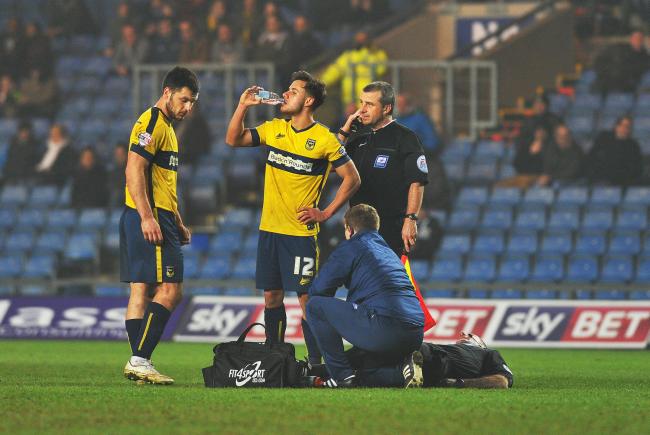
My first away game was in 1982, 5th Round FA Cup tie against Coventry. My first away game experience was the moment we got out of the car having parked up near to Highfield. An Oxford fan sprinted past us pursued by a gang of Coventry fans. It was like a scene out of Green Street, or a template for most of Danny Dyer's career. The day got significantly worse; we lost 4-0 but the whole experience was scarred by Oxford slinging seats over my 9-year-old head and onto the pitch. Just before the final whistle a hassled policeman told us to throw our scarves away if we wanted to get out of the ground safely.
In the intervening 23 years, I like to think I know football crowds, as intimidating as they can appear when at their most rabid, if you understand its ebb and flow, then you're generally OK.
On Friday against Wycombe I got in the away end and tried to work out where I was sitting. I like to sit in my allocated seat, not because I want what's rightfully mine, but because I can't handle the rejection and humiliation when someone comes up and tries to claim the seat I'm sitting in. As I counted along the seats and rows I realised I was right in the middle of the middle, in amongst, what you might call, the hardcore.
But, I couldn't get to it and the stewards were stopping people from getting into that area of the stand because it was too full. So I headed towards the more sedate and sparsely populated area of the stand towards the Frank Adams Stand, a doppelganger for our own South Stand.
We kicked off while large groups were still filing in; the uniform was familiar; Stone Island jumpers, Adidas trainers; the fashion of today, yet identical to how it was 20 years ago, which in itself was of the fashion of twenty years before that. They, presumably, wanted to take up position behind the goal, but they, instead, were ushered beyond that position. Soon, they were stood amongst me.
We kicked off and there was a tangible buzz amongst my new friends. They were bright, we were brighter; Rose; a revelation over the last 2 games, Roofe immaculate. The two combined playing the kind of football Appleton has dreamed about all season. 1-0. Carnage. The bloke standing next to me, a bag of jitters and yelps takes off his coat, throws it to the floor and screams a primal scream. Then, Rose and Roofe reverse to create a second. Mayhem.
This was a cue for the latecomers to poor down the stand and straight through the wholly inadequate perimeter fence; a series of crash mats held up by off-cuts of other crash mats. The instant collapse of the 'wall' exacerbates the problem as fans and stewards stumble over the barriers as they go flying. Nobody knows what's going on, who knocked who and what was an accident and what was deliberate. There's a confrontation with a steward and an Oxford fan throws a punch. Not cool. The steward to his credit doesn't move, let alone retaliate. Ryan Clarke tries to call for calm from his goal.
Order begins to get restored, we're 2-up and the mood in the stands is euphoric, nobody was expecting much from the day, which is probably why so many dawdled in from the pub 10 minutes after kick-off. We came in hope more than expectation. Stories are exchanged about great away days; Chappers' free kick against Burton, Stuart Massey hanging off the crossbar, the bloke next to me says it was a Good Friday game; I restrain myself from correcting him (it was Bank Holiday Monday).
Half time comes, this is on, we've been excellent. Nobody goes to football for half time entertainment, but Wycombe haven’t bothered and the place is strangely subdued given the frantic opening 45 minutes.
Second half and our frailties and their efficiencies intertwine and they pull a goal back. In the stands the banter subsides; it’s amazing how 2-0 can feels like heaven but 2-1 feels like you're standing on the abyss. It's not just about the potential to lose, it's about the potential humiliation of losing from 2-0 up. But, we are invested in this now. On the way in, I was questioned by a drunk Oxford fan as to who I was following ‘are you Oxford?’ he said ‘I’m Oxford and I don’t have a fucking clue why I’m here.’
It was this kind of fixture; we came out of duty, but something was taking grip. We had celebrated 2-0 as if it were the title itself, and now that was under threat. As a white horse ambled across the hillside above the stadium, inside Adams Park.we needed this win, for the points, but more for the pride.
The game remained open though, they attacked, we hit them on the break and the clock ticked on. we attacked again, Hilton fell to the floor under a challenge, he stayed there but the game wasn’t stopping and he knew it. He jumped to his feet, one of those miracle recoveries that infuriates opposing fans. He looks up and and suddenly finds himself an option for Danny Rose; Rose feeds him and there’s Roofe with a scuffed shot across the goal. It was nothing like Tommy Craddock’s wonder strike of two years ago or Nicky Wroe’s beauty last year, but it goes in. More delirium.
Cushion restored, now it’s a question of seeing it out - game management - something we’ve struggled with all season. The clock skips on. Is there a fire drill? No, but there is a trickle of Wycombe fans making for the exits. Have they given up that ghost or are they just taking a prudent view on Wycombe’s match day traffic problems? The trickle becomes a flood; yes, they definitely think this is a done deal, and, the wisdom of crowds says that they must be right.
80 minutes turns into 85 into 89, a Wycombe strike canons off Mullins and then Clarke and goes for a corner; one of those incidents that convinces you that the gods of football are with you that day. But moments later and another far post cross and it’s 3-2. Those who are left in the Wycombe stands are buoyed, could they snatch an unlikely point? I have to remind myself that a point would have been a great outcome before the game, it wouldn't feel like that given what's gone on before.
The board goes up; 6 minutes; Wycombe roar, there’s a ripple across the Oxford end ‘where did that come from?’. And, for once, we’ve got a point; where DID that come from? Sure, we’ve slowed the game down, substitutes had walked off from the opposite side of the pitch; but everyone does that; but that sort of behaviour never usually results in six minutes. It just feels like it appeals to the referees sense of theatre.
But, those minutes drift by, Clarke collects high, hopeless passes with ease, each time it releases a moment of relief. The whistle goes, 3-2, it’s been nearly 10 years since we last dropped a point at Adams Park. Survival now seems almost a certainty. But the steel and fight offers the relief from an otherwise abject season. The players, sodden in the rain, look exhausted but elated. We are, for once, as one.
Shame it wasn’t a derby, really.
Monday, April 06, 2015
Thursday, April 02, 2015
Conscious uncoupling
When Patrick Hoban finally popped up to grab his first goal against Carlisle on Saturday the bloke next to me turned around and said ‘He didn’t have time to think about that one’.
He was right, everything about it forced Hoban to draw from his instincts. Sure, he had to make a conscious effort to move to the front post but from there on he didn’t have time to think. The pace and height of the cross and the fact he was at the near post meant that all he could do was make contact and guide it somewhere towards the top corner; which was the only place the ball was going to go in.
It wasn't lucky, he just didn’t have to think about whether to pass or shoot, or to put the ball left, right or down the middle. Everything had to be done in his sub-conscious; a deep seated learnt behaviour which helped him score a hat full of goals in Ireland. It’s the proverbial ball going in off the backside of a striker; not something he is able to think about, he just does it.
Hoban must have been starting to wonder what he had to do to score, strikers never claim to be affected but this sort of thing, but it must have been nagging away. Football is a callous business, if you don’t perform, you’re out of a job. With each chance another doubt sneaks into your head; then you start to over-think; trying to consciously do the right things when all you really should be doing is letting it flow.
Hoban isn’t the only one who has arrived at the club to find themselves struggling to do the things they’ve done naturally all their lives. Do we, as a club, have something about us that drags players off form?
Perhaps, we’re one of a tiny number of teams who have managed to enjoy both success at the top of the English game and demotion from the league altogether. Only Luton and Wimbledon can say something similar and both of them will argue there were mitigating factors in their failings. For us, failure seems to have been almost wholly self inflicted through our own complacency.
We're unusual in that there are people in the crowd who have seen us win a major trophy at Wembley and lose to Tonbridge Angels (or whatever you might consider our 'low' to have been in the last decade). Amongst us walks people looking for a sign that we’re about to head off back towards the top of the game and those who are looking for signs another pending disaster.
There is a theory that America suffers far greater social tension than other countries because it promotes the full breadth of what is possible in life. Self-made multi-millionaires from poor backgrounds - like rappers and sportsmen - are celebrated as living the American Dream, even if the reality is that for almost everyone living in a ghetto in the US, that’s exactly where they will stay for their whole lives. That sense of failure that most people experience, and perhaps the sense of being deprived or cheated out of their birthright, drives social tension and unrest.
In a class-based system there is 'comfort' that you are amongst your own and a degree of certainty about where your future lies. Although you might want more money and opportunities in life, the angst resulting from not being able to achieve it is far worse. It’s part of life’s moral maze as to which is more right; a restrictive system which has the benefit of certainty, or the open system in which most are likely to feel the pain of failure.
So, we are neither a superpower where success is a Champions League win and a failure is an FA Cup win, nor are we a no ranking lower league stalwart whose purpose in life is to provide little more than a mild diversion in life. Because we have experienced the breadth of what is possible, are we like America, ridden with above average amounts of angst?
If we have a culture prone to angst then perhaps, this could affect new players in a way they might not elsewhere. When players are beginning to suffer angst, that's when doubt creeps in and the subconscious skills and abilities are forced into the conscious mind. If players have to consciously think how to play, then they are far less likely to be able to perform. It may be something deep in our DNA.
He was right, everything about it forced Hoban to draw from his instincts. Sure, he had to make a conscious effort to move to the front post but from there on he didn’t have time to think. The pace and height of the cross and the fact he was at the near post meant that all he could do was make contact and guide it somewhere towards the top corner; which was the only place the ball was going to go in.
It wasn't lucky, he just didn’t have to think about whether to pass or shoot, or to put the ball left, right or down the middle. Everything had to be done in his sub-conscious; a deep seated learnt behaviour which helped him score a hat full of goals in Ireland. It’s the proverbial ball going in off the backside of a striker; not something he is able to think about, he just does it.
Hoban must have been starting to wonder what he had to do to score, strikers never claim to be affected but this sort of thing, but it must have been nagging away. Football is a callous business, if you don’t perform, you’re out of a job. With each chance another doubt sneaks into your head; then you start to over-think; trying to consciously do the right things when all you really should be doing is letting it flow.
Hoban isn’t the only one who has arrived at the club to find themselves struggling to do the things they’ve done naturally all their lives. Do we, as a club, have something about us that drags players off form?
Perhaps, we’re one of a tiny number of teams who have managed to enjoy both success at the top of the English game and demotion from the league altogether. Only Luton and Wimbledon can say something similar and both of them will argue there were mitigating factors in their failings. For us, failure seems to have been almost wholly self inflicted through our own complacency.
We're unusual in that there are people in the crowd who have seen us win a major trophy at Wembley and lose to Tonbridge Angels (or whatever you might consider our 'low' to have been in the last decade). Amongst us walks people looking for a sign that we’re about to head off back towards the top of the game and those who are looking for signs another pending disaster.
There is a theory that America suffers far greater social tension than other countries because it promotes the full breadth of what is possible in life. Self-made multi-millionaires from poor backgrounds - like rappers and sportsmen - are celebrated as living the American Dream, even if the reality is that for almost everyone living in a ghetto in the US, that’s exactly where they will stay for their whole lives. That sense of failure that most people experience, and perhaps the sense of being deprived or cheated out of their birthright, drives social tension and unrest.
In a class-based system there is 'comfort' that you are amongst your own and a degree of certainty about where your future lies. Although you might want more money and opportunities in life, the angst resulting from not being able to achieve it is far worse. It’s part of life’s moral maze as to which is more right; a restrictive system which has the benefit of certainty, or the open system in which most are likely to feel the pain of failure.
So, we are neither a superpower where success is a Champions League win and a failure is an FA Cup win, nor are we a no ranking lower league stalwart whose purpose in life is to provide little more than a mild diversion in life. Because we have experienced the breadth of what is possible, are we like America, ridden with above average amounts of angst?
If we have a culture prone to angst then perhaps, this could affect new players in a way they might not elsewhere. When players are beginning to suffer angst, that's when doubt creeps in and the subconscious skills and abilities are forced into the conscious mind. If players have to consciously think how to play, then they are far less likely to be able to perform. It may be something deep in our DNA.
Wednesday, March 25, 2015
Unlocking the code
Among Michael Appleton’s increasing scrapheap of soundbites the one about finding the right DNA for the club endures above almost all others. To be fair to Appleton, I’m not sure he actually said it, that could have been Mark Ashton, but it is a philosophy he stands by.
Actually, DNA isn’t a bad analogy to use if you apply it properly. DNA is frequently presented as a mystery of the universe, a light-force, a product of some unknown power. This isn’t surprising because what DNA does is remarkable.
However, DNA is a molecule containing a code, a sequence of instructions that, astonishingly, give us life. Now, given that logic is the product of us humans and humans define what science and logic is, then DNA isn’t a mystical thing, it is the origin of logic and rationality. Finding the right DNA is not channelling some mythical power source, its applying logic, solving a code which will result in success.
To illustrate where Michael Appleton has got it wrong is to look at how codes work, how DNA works. Matthew Syed in his book Bounce talks about this in the context of learning. Here’s a code which is a sequence of eleven letters:
A J O M X K I N H P A
If I asked you to remember that code, you would probably be able to remember perhaps 4 or 5 of the letters. Moreover, if I asked you to tell me what it meant, you would have no idea.
Here’s another eleven letter code:
A B B R E V I A T E D
If I asked you to remember that code, then chances are you would be able to rattle them off without a second thought. Not only that, you would probably be able to tell me what the code meant.
That’s because we have developed a sophisticated set of tools to interpret that code, we understand them as letters, group letters together to make sounds, we group sounds to make words, and then we have a reference library of meanings to attach to those words.
Football management is infinitely more difficult than this, of course, the number of variables run into billions when you combine players' attributes with injury and age with opponents and available resources and so on. Nobody should pretend this is easy.
However, the point still stands, because there is one utterly critical and controllable fact that has made establishing our DNA, our code to success, virtually impossible.
I chose eleven letter sequences in the above because there are eleven players in a football team. Say each letter represents a player, the order in which the players play should be recognisable if we’re to decode a team’s DNA. We know the first syllable is ABB, we know, because of the letters around it the ‘e’ is pronounced ‘ee’ and the second ‘a’ as ‘ay’. Each letter has meaning, but each letter also gives meaning to the other letters. A word is a surprisingly sophisticated code when you think about it, but we can solve it in a flash through endless hours of learning.
But, what Michael Appleton is doing is changing the code constantly by signing more and more players, replacing one with another. The changes are bewildering; it’s like asking the team to solve a code where a letter changes constantly. Keeping up with the letters in the code is hard enough, giving it meaning is impossible.
While we can provide endless arguments about resources and the pitch, the swapping of players is utterly controllable. Even if you take the difficult code above, with enough time you would begin to remember it, I could even give it meaning – like having a code to unlock a padlock. So, even a sub-optimal code is better than one which is changing all the time.
Of course in the perfect world you stumble across a DNA that works straight away, but we seem to have changed almost everything about the team on a continual basis. Quite how that is expected to deliver success, I have no idea.
Actually, DNA isn’t a bad analogy to use if you apply it properly. DNA is frequently presented as a mystery of the universe, a light-force, a product of some unknown power. This isn’t surprising because what DNA does is remarkable.
However, DNA is a molecule containing a code, a sequence of instructions that, astonishingly, give us life. Now, given that logic is the product of us humans and humans define what science and logic is, then DNA isn’t a mystical thing, it is the origin of logic and rationality. Finding the right DNA is not channelling some mythical power source, its applying logic, solving a code which will result in success.
To illustrate where Michael Appleton has got it wrong is to look at how codes work, how DNA works. Matthew Syed in his book Bounce talks about this in the context of learning. Here’s a code which is a sequence of eleven letters:
A J O M X K I N H P A
If I asked you to remember that code, you would probably be able to remember perhaps 4 or 5 of the letters. Moreover, if I asked you to tell me what it meant, you would have no idea.
Here’s another eleven letter code:
A B B R E V I A T E D
If I asked you to remember that code, then chances are you would be able to rattle them off without a second thought. Not only that, you would probably be able to tell me what the code meant.
That’s because we have developed a sophisticated set of tools to interpret that code, we understand them as letters, group letters together to make sounds, we group sounds to make words, and then we have a reference library of meanings to attach to those words.
Football management is infinitely more difficult than this, of course, the number of variables run into billions when you combine players' attributes with injury and age with opponents and available resources and so on. Nobody should pretend this is easy.
However, the point still stands, because there is one utterly critical and controllable fact that has made establishing our DNA, our code to success, virtually impossible.
I chose eleven letter sequences in the above because there are eleven players in a football team. Say each letter represents a player, the order in which the players play should be recognisable if we’re to decode a team’s DNA. We know the first syllable is ABB, we know, because of the letters around it the ‘e’ is pronounced ‘ee’ and the second ‘a’ as ‘ay’. Each letter has meaning, but each letter also gives meaning to the other letters. A word is a surprisingly sophisticated code when you think about it, but we can solve it in a flash through endless hours of learning.
But, what Michael Appleton is doing is changing the code constantly by signing more and more players, replacing one with another. The changes are bewildering; it’s like asking the team to solve a code where a letter changes constantly. Keeping up with the letters in the code is hard enough, giving it meaning is impossible.
While we can provide endless arguments about resources and the pitch, the swapping of players is utterly controllable. Even if you take the difficult code above, with enough time you would begin to remember it, I could even give it meaning – like having a code to unlock a padlock. So, even a sub-optimal code is better than one which is changing all the time.
Of course in the perfect world you stumble across a DNA that works straight away, but we seem to have changed almost everything about the team on a continual basis. Quite how that is expected to deliver success, I have no idea.
Friday, March 20, 2015
Standard response
When Leo Roget arrived at the club in 2004 I thought we’d made a good signing. I’d heard of Roget, which was a good start; it was one of those distinctive names that echoed across the lower-leagues. We had been in reasonably good shape on the pitch, the previous season we had a solid back-four with Andy Crosby and Matt Bound and, although they’d left the season before, it seemed like we were learning lessons from the past and that Roget would fit right in. Plus, he was coming from Rushden, who at the time were nouveau riche and seemed to be going places.
But Roget’s first season was terrible, he was gangly and awkward, not a patch on his predecessors. If he used his height it wasn’t to dominate strikers, it was to fall on top of them. The following season he improved, in fact, he was a stand-out player. Fans seemed to like him and sang his name. By the end of that season, though, we’d been relegated from the Football League. So, did Roget really improve or did our standards drop? Did he play better or did he have to do more defending and blocking because we were getting worse?
Presumably one day Michael Appleton will be sitting in an interview for a new job and his prospective employer will ask about his achievements at Oxford. He may have to think hard, but perhaps he will cite this season’s highlight; the double over Bury.
That it: the highlight of our season so far is doing the double over Bury. In fact, up until Tuesday night, we were considered to be ‘in form’; a form which had seen us win 3 in 10, score 8, climb to 17th and be 9 points clear of relegation. Of relegation.
The fact is that the win at Bury shouldn’t have been a reason for celebration; it should have been a wake-up call. As decent as Bury might be this season, we should be expecting to pick off at least a couple of promotion chasers away from home, more if we have ambitions to go up ourselves. We should be expecting to win against Plymouth and we should definitely, definitely, definitely beat Hartlepool.
This is not because we deserve better because of who we are, progressively as the season has passed we’ve allow our standards to drop. At first it was good performances but bad results, then it was wins against poor teams, then it was a sense of celebration that our relegation fears were easing. Draws were celebrated as wins because we never seem to win. Now we’re losing at home to the bottom team in the division and Michael Appleton is applauding our ‘effort’.
He knows he is defending the indefensible now. I agree with him that the players put in a lot of effort against Hartlepool, but the merry-go round of players throughout the season means that for all the effort we remain utterly listless. There is no system. Does anyone know how Roofe or Gnanduillet want the ball in order to score? Well, no because neither have played more than a handful of games for Oxford and neither have the players passing to them. No wonder it’s so disjointed.
Appleton, by his own admission doesn’t have an angry gear, so he’s going to be objective and look for learning points and positives. It’s a good quality to have if you’re coaching youngsters who make lots of mistakes in the process of learning, but managing experienced professionals who are tired, demoralised and battle weary is different. Managers need to show players where they can go if standards do drop whether that be through a volcanic temper or whatever. Plus, they need to show it as the merest inclination of a problem; like the time Chris Wilder (yes him) criticised us for winning 4-0 against Eastbourne after being poor in the second half.
Slowly but surely corners have been cut, standards have slipped and the previously unacceptable has become acceptable.
A spineless defeat to the bottom club in the division – who are in dire trouble on and off the pitch - removes any last shred of credibility Appleton had in claiming that his philosophy will work given time. It’s like going down a hill with worn brake pads; you just have to hope something will stop you because you can’t rely on what you thought you had. This has been coming for a long time, but any lingering hope that we’re going in the right direction has been cast into the dustbin.
Where now? It’s so hard to imagine a scenario now where Appleton not just turns this round but sustains an upward trajectory toward the play-offs and beyond, this season or next. The squad is a mess of panic signings and loanees, players we’ve bought or haven’t bought, players that we’ve announced and never seen sight nor sound of. These are his players working to his confused philosophy stuck in a vortex between what is ‘right’ and what is needed. In order to change, he’s going to have to back down admit he’s been wrong – wrong players, wrong tactics. Not only will he lose face, this is going to take time or money or both to sort out. People are going to get hurt. I can’t see him doing that.
But, he’s not going to resign either; his managerial career has become an absolute wreck with not only this debacle on his CV, but also some of the football league’s greatest basket cases – Portsmouth, Blackburn, Blackpool – all with his name on them. It’s not all been his fault – far from it - but he knows how it’s difficult to shake a reputation.
So, we're left with one option… Mark Ashton, over to you.
Tuesday, March 03, 2015
Plan B?
When we opened the season with four consecutive league defeats and without a win in nine, there were those who applauded the style, if not the results, that Michael Appleton was trying to produce. The more sceptical pointed out that not only were the results not coming, that come the long winter months, the weather would ensure that things could only get worse.
The quality of pitches this season seems to have become more of an obsession than in the past. Perhaps it is because of the ubiquity of the lush, green carpets of the Premier League that we have come to believe is the norm. Maybe it is the product of extreme weather resulting from global warming. Maybe it's the London Welsh obsession, although the obsession doesn't seem limited to the state of our pitch. Maybe it’s a hidden product of the economic downturn where clubs are cutting corners to save costs.
Certainly the expectation that pitches should be green and lush throughout the season is a modern phenomenon. In the 70s and 80s, rutted, muddy pitches in January and February were the norm, it became a great leveller that ensured FA Cup giant killings were more likely. Football, perhaps, wasn’t viewed through the filter of the aesthetic, as it is today, but instead through one of dour pragmatism. It was less important that a game was good and played the right way, more important that it simply happened.
Some seem to be under the odd illusion that lower league players cannot play football on grassless pitches. And that this is at the heart of our problems; because the quality of pitches is awful, we cannot play our way. On the contrary, this is surely much more of a norm for most of them.
Michael Appleton applauded his team’s ‘combativeness’, ‘organisation’ and ‘professionalism’ in the draw against Portsmouth. All terms that wouldn’t have been out of place in a Chris Wilder post-match interview. Incidentally, for those who don’t track this kind of thing, Mr Wilder, with his dull, defensive football, is currently at the helm of the division’s leading goalscorers, the boring sod.
Like last year’s memorable 4-1 reverse, the occasion of the Pompey game probably overstated the result on Saturday. Away draws at Morecambe or Wimbledon - teams directly above and below Pompey - would have been considered solid results rather than some something akin to a win. The 12th Man of Fratton Park is probably the complete opposite at the moment as the visitors thrive on the novelty while the hosts whither with fear. Something we know about only too well.
Organisation and combativeness are both qualities that take you far in League 2, particularly on pitches which won’t allow the ball to run true. It has become more evident in our game in recent weeks and it seems little coincidence that Jake Wright and Ryan Clarke, amongst other warrior types, have finally found some form. It seems that they are relying on their instincts and strengths - honed on the awful pitches of League 2 and the Conference - rather than obsessing over playing the game the right way.
Is this the emergence of a Plan B? A conscious move away from the FA’s training text book towards the cold realities of the lower leagues? Appleton is not clear on the matter. My instinct would say that it’s a happy accident, although the signing of the lanky target man Armand Gnanguillet might suggest otherwise. The key is whether Appleton will learn from this year’s experience or stick pig-headedly to the philosophy. Will he be fooled by the return of beautiful lush turf come August?
Morecambe update
I have some sympathy for Michael Appleton after the draw against Morecambe. This 'trench warfare' football never looks good when you're losing. We were far from outplayed, as we were against Shrewsbury, Wycombe and Southend, and in the end the same performance could easily have produced a defeat, a win as well as the draw we got.
The problem he has is what got us here in the first place; too many signings, too much rhetoric, too many false dawns and corners turned. People were quick to jump on his pre-match comment that this was the group of players he wanted all along. That was a daft comment - similar the 'no plan B' statement at the start of the year - which was always going to come back to haunt him.
Because he is so backed into a corner with his previous statements about not being one for compromise, it's difficult to know whether he is genuinely learning from this season's experience - as it appears on the pitch - or whether, as his interviews seem to imply - he's blind to the realities of what he's dealing with.
The quality of pitches this season seems to have become more of an obsession than in the past. Perhaps it is because of the ubiquity of the lush, green carpets of the Premier League that we have come to believe is the norm. Maybe it is the product of extreme weather resulting from global warming. Maybe it's the London Welsh obsession, although the obsession doesn't seem limited to the state of our pitch. Maybe it’s a hidden product of the economic downturn where clubs are cutting corners to save costs.
Certainly the expectation that pitches should be green and lush throughout the season is a modern phenomenon. In the 70s and 80s, rutted, muddy pitches in January and February were the norm, it became a great leveller that ensured FA Cup giant killings were more likely. Football, perhaps, wasn’t viewed through the filter of the aesthetic, as it is today, but instead through one of dour pragmatism. It was less important that a game was good and played the right way, more important that it simply happened.
Some seem to be under the odd illusion that lower league players cannot play football on grassless pitches. And that this is at the heart of our problems; because the quality of pitches is awful, we cannot play our way. On the contrary, this is surely much more of a norm for most of them.
Michael Appleton applauded his team’s ‘combativeness’, ‘organisation’ and ‘professionalism’ in the draw against Portsmouth. All terms that wouldn’t have been out of place in a Chris Wilder post-match interview. Incidentally, for those who don’t track this kind of thing, Mr Wilder, with his dull, defensive football, is currently at the helm of the division’s leading goalscorers, the boring sod.
Like last year’s memorable 4-1 reverse, the occasion of the Pompey game probably overstated the result on Saturday. Away draws at Morecambe or Wimbledon - teams directly above and below Pompey - would have been considered solid results rather than some something akin to a win. The 12th Man of Fratton Park is probably the complete opposite at the moment as the visitors thrive on the novelty while the hosts whither with fear. Something we know about only too well.
Organisation and combativeness are both qualities that take you far in League 2, particularly on pitches which won’t allow the ball to run true. It has become more evident in our game in recent weeks and it seems little coincidence that Jake Wright and Ryan Clarke, amongst other warrior types, have finally found some form. It seems that they are relying on their instincts and strengths - honed on the awful pitches of League 2 and the Conference - rather than obsessing over playing the game the right way.
Is this the emergence of a Plan B? A conscious move away from the FA’s training text book towards the cold realities of the lower leagues? Appleton is not clear on the matter. My instinct would say that it’s a happy accident, although the signing of the lanky target man Armand Gnanguillet might suggest otherwise. The key is whether Appleton will learn from this year’s experience or stick pig-headedly to the philosophy. Will he be fooled by the return of beautiful lush turf come August?
Morecambe update
I have some sympathy for Michael Appleton after the draw against Morecambe. This 'trench warfare' football never looks good when you're losing. We were far from outplayed, as we were against Shrewsbury, Wycombe and Southend, and in the end the same performance could easily have produced a defeat, a win as well as the draw we got.
The problem he has is what got us here in the first place; too many signings, too much rhetoric, too many false dawns and corners turned. People were quick to jump on his pre-match comment that this was the group of players he wanted all along. That was a daft comment - similar the 'no plan B' statement at the start of the year - which was always going to come back to haunt him.
Because he is so backed into a corner with his previous statements about not being one for compromise, it's difficult to know whether he is genuinely learning from this season's experience - as it appears on the pitch - or whether, as his interviews seem to imply - he's blind to the realities of what he's dealing with.
Wednesday, February 25, 2015
Feed the fans and the rest will follow
Oxford United’s first ever tweet said “Testing to see if anyone spots we are here.” It was a typical first tweet of the the time which was populated mostly by techie, marketing and media types; early adopters who tried this stuff out with no real expectation as to whether it would take off or not. The club adopted the handle ‘OUFClive’; it was probably the best they could come up with on a quiet afternoon, a decision made with little consideration to social media strategies or such piffle.
Followers began to notice that, when read quickly, the ‘Clive’ bit stuck out. It became a running joke that the club’s Twitter account was actually someone called Clive. ‘Clive’ played along; he became our mate at the football. Even the top brass at the club got involved with Kelvin Thomas once playing the role of Clive for a pre-season game in the US.
Then, recently, without warning, the club changed its handle to OUFCOfficial. There was consternation; Clive, our mate at the football, became ‘official’; and as we know, nothing in football that is ‘official’ is any good - referees, police, stewards.
It's been suggested that it was changed for the club to appear more professional. A hashtag was introduced; #together; which, in the current climate seems a bit passive aggressive to me. If you’re not part of the solution, you’re part of the problem, that sort of thing. Context is everything; if the club had used the hashtag #believe during the Malcolm Boyden campaign in 2009, I would have been on board. Ultimately, these things work when they reflect how you feel rather than tell you how to feel. I did ‘believe’ in 2009, I don’t really feel ‘together’ in 2015.
Clive was a rare piece of fan-driven PR that worked well, and the club’s drive for so called professionalism wiped it out. Football clubs, particularly in the lower leagues need to recognise and capitalise on the wonkiness of football clubs not try to eradicate it to present a facade of credibility.
With every new regime or manager, history tends to get wiped out and everything starts again. Apart from in the fans, of course, we treasure the past. Successive manager’s have vocally criticised those who are nostalgic, but it’s a key driver for why we turn up each week; we want to try and recreate or build on the magic of the past that has made us supporters in the first place. If it were a wholly logical decision based on the quality of the service being provided, our crowds would be so low the club would be able to phone everyone to check if they were coming each week.
This isn’t just romantic whimsy, there’s money to be had in nostalgia-porn; on Saturday I went into the club shop, I had an itch to spend some money, I’ve no idea why. I couldn’t find anything but generic polyester leisurewear. I’ve been looking for a copy of the 2010 Wembley DVD for ages, but nothing, what about a t-shirt with some oblique in-joke? I would buy something that said, for example, ‘Right side for life’ or ‘Ford, Elliot, Gilchrist, Robinson’. There’s value in the past; it’s a rich seam with a lot of potential; the club should use it.
Then, I walked into the stadium to hear the iconically gravelly voice of Nick Harris commentating on a Peter Rhodes-Brown goal coming over the PA. There were others, a Beauchamp goal, Alfie Potter at Wembley. They played Use Somebody by Kings of Leon and If The Kids Are United by Sham 69. It’s a shame that Gary Glitter’s Do You Wanna Be In My Gang is kind of inappropriate these days, if they played it, I reckon I would have been able to smell the London Road. While, I don’t care much for any of those tracks musically, I don’t come to football to hear new music, they are songs which evoke memories of the past. As far as I can work out, it was a conscious effort to generate some momentum in the face of a potential relegation battle. I was stirred, it felt important to support the club at the moment, not because I like what’s happening at the moment, but because we need to preserve the club and its memories.
It was a masterstroke, we were immersed in the club; it’s history and it’s purpose. If they can sustain and build on it in the future, we may indeed come #together as a club.
But we still need to slot a successful team into this environment. It was probably fitting that the buzzier pre-match atmosphere drifted into the ether once the actual game got underway. It’s probably an appropriate metaphor that the club appears to be finding its feet while the team stumble. The crowd fell into such a silence it was possible to hear the players shouting at each other from the South Stand Upper. It was scrappy and uncomfortable, the application was there, but we still lack quality.
The win was both needed and welcomed, but it didn’t suggest any kind of tuning point in our fortunes. Like a recovering alcoholic who just needs a quiet night in rather than an evening in the pub resisting the optics behind the bar, we needed a normal, comfortable, home win like that as a reminder that we could do it. It was important in that respect. All in all, it confirmed my suspicion that while our league position is deeply uncomfortable, there are just about enough teams in the division who are notably poorer. Despite our woes, relegation shouldn’t be a threat. Nobody is ‘too good to go down’, but avoiding relegation is in our hands. The problem is that while there are six or seven teams notably worse than us, there are still way too many that are notably better.
A good day, with signs of hope, but still a lot to do.
Followers began to notice that, when read quickly, the ‘Clive’ bit stuck out. It became a running joke that the club’s Twitter account was actually someone called Clive. ‘Clive’ played along; he became our mate at the football. Even the top brass at the club got involved with Kelvin Thomas once playing the role of Clive for a pre-season game in the US.
Then, recently, without warning, the club changed its handle to OUFCOfficial. There was consternation; Clive, our mate at the football, became ‘official’; and as we know, nothing in football that is ‘official’ is any good - referees, police, stewards.
It's been suggested that it was changed for the club to appear more professional. A hashtag was introduced; #together; which, in the current climate seems a bit passive aggressive to me. If you’re not part of the solution, you’re part of the problem, that sort of thing. Context is everything; if the club had used the hashtag #believe during the Malcolm Boyden campaign in 2009, I would have been on board. Ultimately, these things work when they reflect how you feel rather than tell you how to feel. I did ‘believe’ in 2009, I don’t really feel ‘together’ in 2015.
Clive was a rare piece of fan-driven PR that worked well, and the club’s drive for so called professionalism wiped it out. Football clubs, particularly in the lower leagues need to recognise and capitalise on the wonkiness of football clubs not try to eradicate it to present a facade of credibility.
With every new regime or manager, history tends to get wiped out and everything starts again. Apart from in the fans, of course, we treasure the past. Successive manager’s have vocally criticised those who are nostalgic, but it’s a key driver for why we turn up each week; we want to try and recreate or build on the magic of the past that has made us supporters in the first place. If it were a wholly logical decision based on the quality of the service being provided, our crowds would be so low the club would be able to phone everyone to check if they were coming each week.
This isn’t just romantic whimsy, there’s money to be had in nostalgia-porn; on Saturday I went into the club shop, I had an itch to spend some money, I’ve no idea why. I couldn’t find anything but generic polyester leisurewear. I’ve been looking for a copy of the 2010 Wembley DVD for ages, but nothing, what about a t-shirt with some oblique in-joke? I would buy something that said, for example, ‘Right side for life’ or ‘Ford, Elliot, Gilchrist, Robinson’. There’s value in the past; it’s a rich seam with a lot of potential; the club should use it.
Then, I walked into the stadium to hear the iconically gravelly voice of Nick Harris commentating on a Peter Rhodes-Brown goal coming over the PA. There were others, a Beauchamp goal, Alfie Potter at Wembley. They played Use Somebody by Kings of Leon and If The Kids Are United by Sham 69. It’s a shame that Gary Glitter’s Do You Wanna Be In My Gang is kind of inappropriate these days, if they played it, I reckon I would have been able to smell the London Road. While, I don’t care much for any of those tracks musically, I don’t come to football to hear new music, they are songs which evoke memories of the past. As far as I can work out, it was a conscious effort to generate some momentum in the face of a potential relegation battle. I was stirred, it felt important to support the club at the moment, not because I like what’s happening at the moment, but because we need to preserve the club and its memories.
It was a masterstroke, we were immersed in the club; it’s history and it’s purpose. If they can sustain and build on it in the future, we may indeed come #together as a club.
But we still need to slot a successful team into this environment. It was probably fitting that the buzzier pre-match atmosphere drifted into the ether once the actual game got underway. It’s probably an appropriate metaphor that the club appears to be finding its feet while the team stumble. The crowd fell into such a silence it was possible to hear the players shouting at each other from the South Stand Upper. It was scrappy and uncomfortable, the application was there, but we still lack quality.
The win was both needed and welcomed, but it didn’t suggest any kind of tuning point in our fortunes. Like a recovering alcoholic who just needs a quiet night in rather than an evening in the pub resisting the optics behind the bar, we needed a normal, comfortable, home win like that as a reminder that we could do it. It was important in that respect. All in all, it confirmed my suspicion that while our league position is deeply uncomfortable, there are just about enough teams in the division who are notably poorer. Despite our woes, relegation shouldn’t be a threat. Nobody is ‘too good to go down’, but avoiding relegation is in our hands. The problem is that while there are six or seven teams notably worse than us, there are still way too many that are notably better.
A good day, with signs of hope, but still a lot to do.
Tuesday, February 10, 2015
Intensity breeds instinct
Now we’re in February, someone you know will, at some point over the coming months, say ‘I can’t believe it’s [enter month] already, it only seems like Christmas was yesterday’. As we get older, the weeks, months and years blur into one long slog. Seasons come and go, Christmases come and go, life passes by in a flash.
There’s a fairly simple explanation for this. As you get older, pretty much every experience is a repeat of a previous experience. If you were to do something genuinely remarkable, then it would last longer as a vivid memory providing the illusion of a extending the year. For most of us, through necessity, life cannot function if all you are doing is having unique experiences; life is more likely to become one long groundhog day.
To break the mundanity, it helps to have something to focus on or look forward to, particularly if you follow Oxford United. Otherwise the season’s blur into one; the kits change, slightly, the players change, slightly, but otherwise, it’s much the same from one year to the next. If you can’t rely on having a decent cup run or, heaven forfend, a successful league season, then it’s the moments, the single fixtures, that make the effort worthwhile.
Saturday’s game against Luton was probably the one banker of the season; a mutual dislike, two teams, not that far apart geographically, with similar histories. The only fixture to have been played in all five of the top divisions in English football. Not a derby, but with some of the characteristics of one. A quarrel neither of is prepared to resolve or back down from; no matter where one of us is, the other one will hunt them down and start the argument again.
It lived up to its billing. A nice big bank of away fans and a vociferous response from the home fans. Niggle, rabbit punches and bickering on the pitch. Good stuff. Intensity was the watchword; the way we played, the atmosphere; it was a fixture unlike any we’ve seen this season.
We benefited from it because we had to play football rather than dwell on The Philosophy. Jake Wright made tackles rather than misdirect cross-field passes. Luton’s fans brought the intensity, their players took it onto the pitch by getting into our players' faces and opening petty feuds. But, it did them no favours, where others have absorbed us and then gently picked us off while we drowned in our own self-importance, they badgered us to play on instinct.
Even on the touchline there was more animation; Derek Fazackerley kicked over a water bottle in frustration, Michael Appleton remonstrated with a linesman after a petty foul late into injury time. Everyone seemed to be enjoying it.
But, that’s pretty much it for the season in terms of an external stimulus triggering us into action, how will we re-create the intensity we need to perform? Mansfield are next at the Kassam, nobody is going to be fired up to teach Junior Brown a lesson. It’s unlikely to come from the touchline; many managers are borderline sociopaths who frighten players into playing at the right intensity regardless of the occasion, Appleton prides himself on his detachment. This has it’s place, of course, but it can leave us needing something else to get us going. It is too much to ask the fans despite what some say (more of that in a minute). A lot of expectation is being placed on this creative midfielder to drive the team forward, it might work, but it's a big job.
In cyclist Michael Hutchinson's book Faster, he describes what happened when he tried to use the psychological technique of visualisation to improve his time trialling. Because he spent so much time thinking through what he did rather than rely on his physical conditioning, his anxiety and stress levels increased and he actually got slower.
With us, without the intensity, there is the tendency to overthink everything rather than simply execute deeply imbedded subconscious ability. The net impact is that performance is more likely to drop than go up; particularly if it repeatedly appears to fail.
And another thing...
The first person on the phone-in was berating Oxford fans for not backing their team despite 'the chairman’s investment'. The first point is that investment is spending money to get a return; by my reckoning Appleton has brought in 17 players since he started, of which six are still at the club (and none of those have played more than five games). The return has been average so it's not investment, it’s just spending. The second thing is that regardless of the cost of bringing in these 17 players; it hasn't yet materialised into results - despite Saturday’s encouraging display, we haven’t won at home since 13th December (with a last minute goal) and before that it was Tranmere in October. So, in fact what the caller was telling Oxford fans to do is attend in less-than-once a month possibility of seeing a win. Results draw crowds not investment, I’m sure the club are aware of that even if the said fan isn't. Oh, and he claimed we all supported Kassam when he was chairman; I think I must have missed that game.
There’s a fairly simple explanation for this. As you get older, pretty much every experience is a repeat of a previous experience. If you were to do something genuinely remarkable, then it would last longer as a vivid memory providing the illusion of a extending the year. For most of us, through necessity, life cannot function if all you are doing is having unique experiences; life is more likely to become one long groundhog day.
To break the mundanity, it helps to have something to focus on or look forward to, particularly if you follow Oxford United. Otherwise the season’s blur into one; the kits change, slightly, the players change, slightly, but otherwise, it’s much the same from one year to the next. If you can’t rely on having a decent cup run or, heaven forfend, a successful league season, then it’s the moments, the single fixtures, that make the effort worthwhile.
Saturday’s game against Luton was probably the one banker of the season; a mutual dislike, two teams, not that far apart geographically, with similar histories. The only fixture to have been played in all five of the top divisions in English football. Not a derby, but with some of the characteristics of one. A quarrel neither of is prepared to resolve or back down from; no matter where one of us is, the other one will hunt them down and start the argument again.
It lived up to its billing. A nice big bank of away fans and a vociferous response from the home fans. Niggle, rabbit punches and bickering on the pitch. Good stuff. Intensity was the watchword; the way we played, the atmosphere; it was a fixture unlike any we’ve seen this season.
We benefited from it because we had to play football rather than dwell on The Philosophy. Jake Wright made tackles rather than misdirect cross-field passes. Luton’s fans brought the intensity, their players took it onto the pitch by getting into our players' faces and opening petty feuds. But, it did them no favours, where others have absorbed us and then gently picked us off while we drowned in our own self-importance, they badgered us to play on instinct.
Even on the touchline there was more animation; Derek Fazackerley kicked over a water bottle in frustration, Michael Appleton remonstrated with a linesman after a petty foul late into injury time. Everyone seemed to be enjoying it.
But, that’s pretty much it for the season in terms of an external stimulus triggering us into action, how will we re-create the intensity we need to perform? Mansfield are next at the Kassam, nobody is going to be fired up to teach Junior Brown a lesson. It’s unlikely to come from the touchline; many managers are borderline sociopaths who frighten players into playing at the right intensity regardless of the occasion, Appleton prides himself on his detachment. This has it’s place, of course, but it can leave us needing something else to get us going. It is too much to ask the fans despite what some say (more of that in a minute). A lot of expectation is being placed on this creative midfielder to drive the team forward, it might work, but it's a big job.
In cyclist Michael Hutchinson's book Faster, he describes what happened when he tried to use the psychological technique of visualisation to improve his time trialling. Because he spent so much time thinking through what he did rather than rely on his physical conditioning, his anxiety and stress levels increased and he actually got slower.
With us, without the intensity, there is the tendency to overthink everything rather than simply execute deeply imbedded subconscious ability. The net impact is that performance is more likely to drop than go up; particularly if it repeatedly appears to fail.
And another thing...
The first person on the phone-in was berating Oxford fans for not backing their team despite 'the chairman’s investment'. The first point is that investment is spending money to get a return; by my reckoning Appleton has brought in 17 players since he started, of which six are still at the club (and none of those have played more than five games). The return has been average so it's not investment, it’s just spending. The second thing is that regardless of the cost of bringing in these 17 players; it hasn't yet materialised into results - despite Saturday’s encouraging display, we haven’t won at home since 13th December (with a last minute goal) and before that it was Tranmere in October. So, in fact what the caller was telling Oxford fans to do is attend in less-than-once a month possibility of seeing a win. Results draw crowds not investment, I’m sure the club are aware of that even if the said fan isn't. Oh, and he claimed we all supported Kassam when he was chairman; I think I must have missed that game.
Tuesday, February 03, 2015
Squad of thrones
Oxford United’s squad is becoming more like Game of Thrones with every passing week. For those who don’t watch it, Game of Thrones is a fantasy drama of mind boggling scale, good guys and bad guys get killed with similar frequency, good guys become bad guys, bad guys become good guys, and good guys and bad guys gang up to kill other good guys and bad guys. It is hard to keep up with what everyone is doing and who you’re supposed to like and hate. Sometimes you have to step back and take stock.
In simple terms, our squad is made up of two houses; Wilderians and Appletonians, with Danny Hylton being part of neither. Or both, perhaps? It would be easy to assume Michael Appleton is simply dismantling the House of Wilder to replace it with the House of Appleton. It certainly seemed like it might be that way when he arrived. Gary Waddock was thrown out the door and Eales and Ashton stepped into Ian Lenagan’s shoes while he was practically still wearing them. Revolution, it seemed, was inevitable.
But, this transfer window, the first in which we’ve seen the House of Appleton in full battle mode has been baffling. Wilderians have gone, but so to have Appletonians, Appletonians have arrived to replace other Appletonians, some Appletonians didn’t even appear to be Appletonians in the first place. So, where the hell are we?
Well, as of training this morning, the raw stats say that we signed six (including Jamie Ashdown this morning) and lost or let go nine. So, in pure numeric terms, we have a squad with three less players than we had at the start.
Starting at the back, Ashdown seems an odd signing, unless there’s something we don’t know about Ryan Clarke's fitness. Clarke's form hasn’t been quite what it's been in the past, but he's hardly a risk. Max Crocombe is an able replacement on the rare occasions he’s needed. Is Ashdown going to replace Clarke? Or sit on the bench vacated by Crocombe? If it's the former, it would seem an unnecessary shuffle, if it’s the latter, what’s the point of that?
At the back, we’ve got a bewildering merry-go-round to deal with. Michael Raynes has gone, although it’s difficult to know what he did wrong. He wasn't Bobby Moore, but he was a willing squad player and solid enough at the back when needed. In his place is Chey Dunkley, who was shakiness personified against Southend. In terms of net gain, at best it’s a zero, perhaps a little worse.
Right, full-backs. Hunt and Newey’s days were probably numbered even under Chris Wilder. They were originally brought in to shore things up after the marauding of Liam Davis and Damien Batt gave one too many heart palpitations. They were pragmatic and dependable, but hardly thrilling. You got the impression they were managing their fitness and effort, not being in the first flushes of youth. Holmes-Dennis and Riley seemed to indicate a loosening of the full-back roles, an introduction of youthful exuberance and attacking flare, part of the New Philosophy. But then… well, we seemed to lose them, which was a bit complacent. Are Skarz and Brindley better? Different? Almost impossible to tell in the short term, but on paper they seem more robust than what we’ve had in the past. I’m sticking my neck out and saying this is an improvement.
Into midfield; Junior Brown was an early Appleton signing who sparkled like a damp firework before disappearing from view. It seems a long time since he was even on the radar, so it’s difficult to know whether we’ve lost anything through his departure. That said, we certainly haven't replaced him or improved that area in the window.
Up front, Campbell fell victim to shambolic contract negotiations, it seems. He was always a long shot and I for one am not that concerned about his departure. Burns had a fine debut, but like so many before him, his form quickly fizzled to nothing. Potter’s departure wasn’t really a surprise as sad as it was to see him go. I suspect Wilder or Waddock would have come to a similar conclusion eventually. I couldn’t say that Burns was an effective replacement for Potter, both had patchy form. McDonald may be a better and more permanent solution. On the face of it, he does seem a good acquisition . That leaves Hoban, who was brought in, I assume, as a banker in the absence of the club securing a deal for Tyrone Barnett, which turned into the most over-blown non-event we’ve had in years. Hoban, like Campbell, was a risk and we can't say he's been a risk worth taking; not yet, at least.
So, we’re weakened in numbers, and probably fractionally ahead in terms of quality per head. We should be able to stay up, though I, for one, don’t think that’s ever been as big a concern as others have suggested. We’re vulnerable, however, because injuries and loss of form could make things very uncomfortable. Particularly as some players will be starting to think about where they will be playing next season, when that disengagement starts, who knows where we might end up?
Above all, a lot of energy has been wasted in deals that never came off, deals that came off but didn’t stick and deals for players that were barely better than what they replaced. All told, a slight gain but a shambolic way to do business.
In simple terms, our squad is made up of two houses; Wilderians and Appletonians, with Danny Hylton being part of neither. Or both, perhaps? It would be easy to assume Michael Appleton is simply dismantling the House of Wilder to replace it with the House of Appleton. It certainly seemed like it might be that way when he arrived. Gary Waddock was thrown out the door and Eales and Ashton stepped into Ian Lenagan’s shoes while he was practically still wearing them. Revolution, it seemed, was inevitable.
But, this transfer window, the first in which we’ve seen the House of Appleton in full battle mode has been baffling. Wilderians have gone, but so to have Appletonians, Appletonians have arrived to replace other Appletonians, some Appletonians didn’t even appear to be Appletonians in the first place. So, where the hell are we?
Well, as of training this morning, the raw stats say that we signed six (including Jamie Ashdown this morning) and lost or let go nine. So, in pure numeric terms, we have a squad with three less players than we had at the start.
Starting at the back, Ashdown seems an odd signing, unless there’s something we don’t know about Ryan Clarke's fitness. Clarke's form hasn’t been quite what it's been in the past, but he's hardly a risk. Max Crocombe is an able replacement on the rare occasions he’s needed. Is Ashdown going to replace Clarke? Or sit on the bench vacated by Crocombe? If it's the former, it would seem an unnecessary shuffle, if it’s the latter, what’s the point of that?
At the back, we’ve got a bewildering merry-go-round to deal with. Michael Raynes has gone, although it’s difficult to know what he did wrong. He wasn't Bobby Moore, but he was a willing squad player and solid enough at the back when needed. In his place is Chey Dunkley, who was shakiness personified against Southend. In terms of net gain, at best it’s a zero, perhaps a little worse.
Right, full-backs. Hunt and Newey’s days were probably numbered even under Chris Wilder. They were originally brought in to shore things up after the marauding of Liam Davis and Damien Batt gave one too many heart palpitations. They were pragmatic and dependable, but hardly thrilling. You got the impression they were managing their fitness and effort, not being in the first flushes of youth. Holmes-Dennis and Riley seemed to indicate a loosening of the full-back roles, an introduction of youthful exuberance and attacking flare, part of the New Philosophy. But then… well, we seemed to lose them, which was a bit complacent. Are Skarz and Brindley better? Different? Almost impossible to tell in the short term, but on paper they seem more robust than what we’ve had in the past. I’m sticking my neck out and saying this is an improvement.
Into midfield; Junior Brown was an early Appleton signing who sparkled like a damp firework before disappearing from view. It seems a long time since he was even on the radar, so it’s difficult to know whether we’ve lost anything through his departure. That said, we certainly haven't replaced him or improved that area in the window.
Up front, Campbell fell victim to shambolic contract negotiations, it seems. He was always a long shot and I for one am not that concerned about his departure. Burns had a fine debut, but like so many before him, his form quickly fizzled to nothing. Potter’s departure wasn’t really a surprise as sad as it was to see him go. I suspect Wilder or Waddock would have come to a similar conclusion eventually. I couldn’t say that Burns was an effective replacement for Potter, both had patchy form. McDonald may be a better and more permanent solution. On the face of it, he does seem a good acquisition . That leaves Hoban, who was brought in, I assume, as a banker in the absence of the club securing a deal for Tyrone Barnett, which turned into the most over-blown non-event we’ve had in years. Hoban, like Campbell, was a risk and we can't say he's been a risk worth taking; not yet, at least.
So, we’re weakened in numbers, and probably fractionally ahead in terms of quality per head. We should be able to stay up, though I, for one, don’t think that’s ever been as big a concern as others have suggested. We’re vulnerable, however, because injuries and loss of form could make things very uncomfortable. Particularly as some players will be starting to think about where they will be playing next season, when that disengagement starts, who knows where we might end up?
Above all, a lot of energy has been wasted in deals that never came off, deals that came off but didn’t stick and deals for players that were barely better than what they replaced. All told, a slight gain but a shambolic way to do business.
Wednesday, January 28, 2015
Realising Lenagan's dream
With five of the thirteen players on duty against Exeter from the youth development system, Saturday saw the realisation of Ian Lenagan's vision of 18 months ago.
Granted, that vision; which forecast a successful Oxford United driven by a core of homegrown talent, was probably borne out of the financial reality he faced rather than some dewy eyed prescience along the lines of Martin Luther King - only Michael Duberry could do that. However, as visions go, it was the most cogent I’ve heard come from the club in forty years. Yes, we’ve had owners stressing the importance of building and then owning a new stadium. But in terms of turning that into a playing reality, that vision rarely stretched much beyond "... and then, um, something something something beat Real Madrid in the final of the Champions League!". Lenagan's visions was realistic, tangible and above all attractive.
Long, Ashby, Ruffels, O’Dowda and Roberts were pivotal in digging Appleton out of yet another mess. It demonstrated what rude health the development system is in. The work done to date is an credit to Chris Allen, who was the player you’d consider least likely to turn out to be a top class coach.
But, is Lenagan's vision the solution to this season? Well, no, not at the moment. The second half against Exeter proved that much. We were bright and switched on in the first half but became conservative and sluggish in the second. Fitness was a factor; it’s asking a lot for a young team to put in a 90 minute shift at the intensity of any League 2 game, let alone one demanding the high technical component that Appleton insists on. ‘Game management’ was another factor. Nathan Cooper persists with this topic week after week with Michael Appleton. He has a point; we seem to approach the natural phases games go through exactly the same way, rather than assess and adapt as the game progresses. Is this part of Appleton's 'No Plan B' philosophy?
Appleton, when pushed on the subject, seemed to imply that organising teams to manage games was difficult, that is, almost impossible to train. And yet, organising a disciplined unit seems a darned sight easier to train than, say, teaching Jake Wright to play like Glenn Hoddle.
And this seems to be at the heart of the problem; while the emergence of Lenagan’s dream should give everyone heart, what we need is a core of players who are going to manage the game on the pitch. In the past we relied on the likes of Wright, Mullins, Clarke, Whing, but these are looking a shadow of their former selves, and, if you add Hunt, Newey and even Constable and Kitson from last year, you have to question why do we seem so devoid of leadership now?
Injuries are always factors; Clarke, Wright and Whing have all suffered recently and each bounce back is inevitably going to be a little less bouncy. There is an issue of playing style; anyone criticising Wright this season is ignoring the style of football he’s suddenly being asked to play. Ask him to be a defender, and he excels, ask him to be a playmaker and he looks deeply uncomfortable. And then there's an issue of age and authority. Appleton isn’t that much older than some of those he manages so it would be far easier for senior players to not respect his authority or ability. This was, apparently, a factor in Dave Kitson’s sudden decision to retire once Appleton arrived at the club. Perhaps some of those older heads, frustrated by how we’ve stalled this season, are doubting their manager’s ability and approach.
If that is happening, Appleton, has the right to bring in people he can work with, but while so many of the core Wilder squad have left or hit poor form, those signed to replace them have been at best patchy, at worst woeful - Riley and Barnett were both established, and then slipped through our fingers, Junior Brown, Carlton Morris and Alex Jakubiak didn't look ready, Will Hoskins and Brian Howard were spent forces before they even appeared at the club. Only Michael Collins and Tareiq Holmes-Dennis have sustained success so far; and Collins was dropped shortly after telling Radio Oxford we were in a relegation fight. Even, Holmes-Dennis, looks in need of a rest after an extended run of games; again, it's a lot to ask of him.
Of the four signed prior to the opening of the window, Campbell and Hobarn have yet to come to terms with the rigours of League 2, Wes Burns seems another with bags of potential but not the endurance to sustain it, and Chey Dunkley looked decidedly shaky against Southend. It's an uninspiring batch of signings so far.
For all the potential we now have at first team level; perhaps the best crop of youngsters I’ve seen at the club in terms of both quality and numbers, we are woefully lacking in leadership (and the motivation to lead) that experience gives, with the transfer window winding shut, time is running out in terms addressing the issue.
Granted, that vision; which forecast a successful Oxford United driven by a core of homegrown talent, was probably borne out of the financial reality he faced rather than some dewy eyed prescience along the lines of Martin Luther King - only Michael Duberry could do that. However, as visions go, it was the most cogent I’ve heard come from the club in forty years. Yes, we’ve had owners stressing the importance of building and then owning a new stadium. But in terms of turning that into a playing reality, that vision rarely stretched much beyond "... and then, um, something something something beat Real Madrid in the final of the Champions League!". Lenagan's visions was realistic, tangible and above all attractive.
Long, Ashby, Ruffels, O’Dowda and Roberts were pivotal in digging Appleton out of yet another mess. It demonstrated what rude health the development system is in. The work done to date is an credit to Chris Allen, who was the player you’d consider least likely to turn out to be a top class coach.
But, is Lenagan's vision the solution to this season? Well, no, not at the moment. The second half against Exeter proved that much. We were bright and switched on in the first half but became conservative and sluggish in the second. Fitness was a factor; it’s asking a lot for a young team to put in a 90 minute shift at the intensity of any League 2 game, let alone one demanding the high technical component that Appleton insists on. ‘Game management’ was another factor. Nathan Cooper persists with this topic week after week with Michael Appleton. He has a point; we seem to approach the natural phases games go through exactly the same way, rather than assess and adapt as the game progresses. Is this part of Appleton's 'No Plan B' philosophy?
Appleton, when pushed on the subject, seemed to imply that organising teams to manage games was difficult, that is, almost impossible to train. And yet, organising a disciplined unit seems a darned sight easier to train than, say, teaching Jake Wright to play like Glenn Hoddle.
And this seems to be at the heart of the problem; while the emergence of Lenagan’s dream should give everyone heart, what we need is a core of players who are going to manage the game on the pitch. In the past we relied on the likes of Wright, Mullins, Clarke, Whing, but these are looking a shadow of their former selves, and, if you add Hunt, Newey and even Constable and Kitson from last year, you have to question why do we seem so devoid of leadership now?
Injuries are always factors; Clarke, Wright and Whing have all suffered recently and each bounce back is inevitably going to be a little less bouncy. There is an issue of playing style; anyone criticising Wright this season is ignoring the style of football he’s suddenly being asked to play. Ask him to be a defender, and he excels, ask him to be a playmaker and he looks deeply uncomfortable. And then there's an issue of age and authority. Appleton isn’t that much older than some of those he manages so it would be far easier for senior players to not respect his authority or ability. This was, apparently, a factor in Dave Kitson’s sudden decision to retire once Appleton arrived at the club. Perhaps some of those older heads, frustrated by how we’ve stalled this season, are doubting their manager’s ability and approach.
If that is happening, Appleton, has the right to bring in people he can work with, but while so many of the core Wilder squad have left or hit poor form, those signed to replace them have been at best patchy, at worst woeful - Riley and Barnett were both established, and then slipped through our fingers, Junior Brown, Carlton Morris and Alex Jakubiak didn't look ready, Will Hoskins and Brian Howard were spent forces before they even appeared at the club. Only Michael Collins and Tareiq Holmes-Dennis have sustained success so far; and Collins was dropped shortly after telling Radio Oxford we were in a relegation fight. Even, Holmes-Dennis, looks in need of a rest after an extended run of games; again, it's a lot to ask of him.
Of the four signed prior to the opening of the window, Campbell and Hobarn have yet to come to terms with the rigours of League 2, Wes Burns seems another with bags of potential but not the endurance to sustain it, and Chey Dunkley looked decidedly shaky against Southend. It's an uninspiring batch of signings so far.
For all the potential we now have at first team level; perhaps the best crop of youngsters I’ve seen at the club in terms of both quality and numbers, we are woefully lacking in leadership (and the motivation to lead) that experience gives, with the transfer window winding shut, time is running out in terms addressing the issue.
Tuesday, January 20, 2015
Teetering?
There was a moment on Saturday when Andy Whing received an simple ball, he mis-controlled and, over-reaching, stabbed it back along the back-four. There was an audibly sharp intake of breath - not for the first time this season - as the back line and Ryan Clarke moved the ball between them as if trying to get rid of a lump of a steaming poo.
It was 2-2 at the time and, fleetingly, I wanted us to concede. Or at least I was curious to see what would happen if we did. I’m not one of those who wants to see us lose in order for the manager to be fired, despite what people seem to think, but there was a moment where I wanted to do a laboratory test, away from the real world, which would establish how the club might respond.
And then we did concede; we’d lost two leads, at home, playing a team playing with 10 men for an hour, it could barely have been worse. Had we won, we could have debated whether the 10 men was a factor, had we drawn, we could have debated how difficult it is to play against 10 men, had we lost against 11 men, we could have debated the relative merits of our opponents. But this was beyond debate, we'd lost. Badly.
So, how do the club handle it? Will we get the relentless positive parping from Eales and Ashton? The steely look in the eye and the challenge to ‘judge us on our actions’. How do they defend it? Outwardly they will support Appleton, the media seem to think he's as safe as houses. This might have been a transitional year, but they surely can't have planned it like this.
There can only be two scenarios where this might not matter; the first is if they don’t care, the second is if they have unstinting belief in The Philosophy.
Let's deal with the first bit; the land deal thesis – the idea that their investment in the club is simply a cover for some massive land deal; either at the Kassam or at Water Eaton; an opportunity to capitalise on the city’s housing crisis, for example.
While its feasible, I don’t believe that this is their sole focus. I’m fairly certain that it’s part of a wider investment plan but every owner from Robert Maxwell onwards has recognised how important stadium ownership is to the club’s future. But they're trying way too hard off the pitch for them to be coldly killing the club off a la Kassam (although I don't think even he planned that initially).
So, what about The Philosophy. Do they have the money to invest unquestionably in The Philosophy, the Plan A and the DNA and all that gubbins? There's not a lot of evidence that they have a bottomless pit of cash; after all they're not investing heavily at the moment? People talk about signing players in the transfer window, but they ignore that we signed four before it even opened, and they're not exactly looking like world beaters.
So, there has to be some limits; a point at which the situation becomes intolerable. I can’t believe they are looking at this and thinking it’s OK, because if they don't improve things soon, it's going to get a whole lot worse.
The thing is, it's not the fans they need to worry about, it’s the customers. We, the fans, will turn up pretty much whatever gets served up, customers - the casuals who only turn up if they’re going to be entertained - will make the difference. We may detest them, but they are the difference between a crowd of 4,000 and a crowd of 9,000, plus they pay more per head. They are much more discerning and selective than us. Turn them off and the club is really in trouble and for Ashton and Eales, things will get much, much more expensive. Even if they give up on the team, they've still got to pay the rent, at least Kassam could give up and not fear that.
How do they, with any credibility, defend their credibility when The Philosophy, which they've talked about with such confidence, disintegrates on first contact with the outside world? Do they smile it out or take action? If they're teetering now, Saturday's game against Exeter could be decisive.
It was 2-2 at the time and, fleetingly, I wanted us to concede. Or at least I was curious to see what would happen if we did. I’m not one of those who wants to see us lose in order for the manager to be fired, despite what people seem to think, but there was a moment where I wanted to do a laboratory test, away from the real world, which would establish how the club might respond.
And then we did concede; we’d lost two leads, at home, playing a team playing with 10 men for an hour, it could barely have been worse. Had we won, we could have debated whether the 10 men was a factor, had we drawn, we could have debated how difficult it is to play against 10 men, had we lost against 11 men, we could have debated the relative merits of our opponents. But this was beyond debate, we'd lost. Badly.
So, how do the club handle it? Will we get the relentless positive parping from Eales and Ashton? The steely look in the eye and the challenge to ‘judge us on our actions’. How do they defend it? Outwardly they will support Appleton, the media seem to think he's as safe as houses. This might have been a transitional year, but they surely can't have planned it like this.
There can only be two scenarios where this might not matter; the first is if they don’t care, the second is if they have unstinting belief in The Philosophy.
Let's deal with the first bit; the land deal thesis – the idea that their investment in the club is simply a cover for some massive land deal; either at the Kassam or at Water Eaton; an opportunity to capitalise on the city’s housing crisis, for example.
While its feasible, I don’t believe that this is their sole focus. I’m fairly certain that it’s part of a wider investment plan but every owner from Robert Maxwell onwards has recognised how important stadium ownership is to the club’s future. But they're trying way too hard off the pitch for them to be coldly killing the club off a la Kassam (although I don't think even he planned that initially).
So, what about The Philosophy. Do they have the money to invest unquestionably in The Philosophy, the Plan A and the DNA and all that gubbins? There's not a lot of evidence that they have a bottomless pit of cash; after all they're not investing heavily at the moment? People talk about signing players in the transfer window, but they ignore that we signed four before it even opened, and they're not exactly looking like world beaters.
So, there has to be some limits; a point at which the situation becomes intolerable. I can’t believe they are looking at this and thinking it’s OK, because if they don't improve things soon, it's going to get a whole lot worse.
The thing is, it's not the fans they need to worry about, it’s the customers. We, the fans, will turn up pretty much whatever gets served up, customers - the casuals who only turn up if they’re going to be entertained - will make the difference. We may detest them, but they are the difference between a crowd of 4,000 and a crowd of 9,000, plus they pay more per head. They are much more discerning and selective than us. Turn them off and the club is really in trouble and for Ashton and Eales, things will get much, much more expensive. Even if they give up on the team, they've still got to pay the rent, at least Kassam could give up and not fear that.
How do they, with any credibility, defend their credibility when The Philosophy, which they've talked about with such confidence, disintegrates on first contact with the outside world? Do they smile it out or take action? If they're teetering now, Saturday's game against Exeter could be decisive.
Wednesday, January 14, 2015
Pottered out the door
It was surely of no surprise to anyone that Michael Appleton has told Alfie Potter that he has, to use Appleton's own mangled analogy, ‘reached his shelf-life’.
Potter’s departure, which we must assume to be fairly imminent, brings the number of players left at the club from the promotion winning team of 2010 to just two – Jake Wright and Ryan Clarke.
Potter was part of the Wilder/Thomas aggressive signing policy in the summer of 2009. On loan from Peterborough, his reputation had been built, in part, through his performance for Havant and Waterlooville where, improbably, they took the lead twice against Liverpool at Anfield in the FA Cup.
He was brought into a squad of big names, big personalities and big bodies – Creighton, Constable, Midson, Green, Bulman.
Despite being slight, fast and tricky, the antithesis of someone like Creighton, he fitted right in, he'd bounce off robust challenges and react to nothing. He played with the arrogance of a team that was going to get promoted; something that shifted the club overnight from one that was a perpetual victim, to one that was simply going to knock over anyone who got in their way.
But, at the same time Potter was young and small; he looks like a little boy; even the name - Alfie Potter - the boy (wing) wizard. In 2010, just before the start of the first season back in League 2, it was reported that he had been arrested in connection with a nightclub stabbing. It turned out that there had been an incident in a club that he was in, and he was the innocent victim of an 'arrest everyone, ask questions later' policing policy.
In some ways, it was most startling that Alfie Potter was in a nightclub at all; was he old enough? In essence, his struggle was always about breaking out from being the youngster with potential into a being a senior and respected professional.
That would have required him to remodel his game; players like Alan Shearer, Steven Gerrard and, perhaps, the best parallel; Ryan Giggs, found that they had to change their games once their natural youthful talents were dismantled by injury and age.
Both affected Potter, but that's not because he was unlucky, just because he was a professional footballer. It's difficult, without the benefit of an army of crack sports scientists, to know quite what he was supposed to do about it.
So Potter was on a hiding to nothing; wingers thrill and frustrate with equal measure, they don't always beat their man or get the cross in. When it works, it works brilliantly, but frequently it doesn't. Even Joey Beauchamp used to drive fans mad with his inconsistency, and most will agree that Beauchamp was one of our best ever.
This season, a bloke behind me can't help himself everytime the ball goes near Potter; 'Ah, here we go again' he'd say in a state of constant dismay before Potter got a chance to do anything. If he lost the ball trying to go past someone or was tackled, it was further proof that he was inept. It's unfair, because every winger is inconsistent. It's just that, once the tide is against you, it's difficult, probably impossible, to turn it back. The writing has been on the wall for a while.
Like Chris Wilder, Potter seems to have been labelled some kind of failure at Oxford, which is sad and wrong. It might be that his time has come, but that's not to say that he hasn't been a success. Take THAT goal. A goal usually ignites a feeling of relief, that you're going in the right direction, but it's an incomplete feeling; a feeling that we need to get another goal, or defend. Even a last minute goal frequently gives the feeling that it offers a platform for the next game or the rest of the season.
Potter's goal at Wembley was a rare and precious thing; the feeling of completeness, a sense of achievement. Football offers so few moments like that; in my near 40 years of supporting Oxford there was the Jeremy Charles' third goal in 1986, the fourth goal against Peterborough in 1996, and Potter's goal in 2010.
Not only that; he pretty much gave us that feeling twice...
Wednesday, December 31, 2014
T'is the season to be jolly?
There are basically two theories about mince pies; either we hate them and tolerate them only at Christmas or we love them and abstain from having them at any other time in the year. The same goes for turkey, Christmas pudding and almost everything else we associate with Christmas. We could quite easily break Christmas - a curry on the 25th December, a mince pie after a barbecue in August, we could buy each other presents on, say, 13th February, just because that would be a nice thing to do. But, it wouldn’t feel right; it wouldn’t be right. We want to believe that Christmas exists, so we defer to its traditions.
It’s much the same with the Eales/Ashton/Appleton revolution; most want it to exist; better football, new stadium, a whole bright future; but for the first time on Boxing Day, it did appear that even the most devout converts were beginning to doubt its existence.
The display itself was gutless. A true demonstration of just how far behind the standard we’ve fallen in the division. Shrewsbury were stronger, faster and more efficient with the ball and far better in every department imaginable. We trudged around trying to pass it on a boggy pitch increasingly tiny triangles; if Shrewsbury weren’t out-muscling us, they were simply waiting for a mistake to happen. When they got the ball, they moved it quickly and looked a continual threat. When they chose to shut us down, they did. It was much the same against Wycombe. It was much the same against Burton.
Post-match, Appleton tied himself up in knots. He was, he said, ‘man enough’ to admit we were beaten by a better team, as if this was a positive. It certainly paints him as an intelligent, reflective, objective individual; all of which are good qualities to have. But it ignores the fact that it’s ultimately his job to ensure we aren’t swept aside by better teams in the manner that we were. No matter that a team is better resourced, we should expect to compete with every team that comes to the Kassam rather than passively wait to see what turns up. He reinforced his normal stance that he wouldn’t be stepping back or ranting and raving at the players; a point he regularly makes. He appeared to take a swipe at the club; pointing out that we’ve not been higher than League 2 for over a decade and that it’s not as if they’re playing in front of big crowds. It’s something that both David Kemp and Chris Wilder did in the past when they were under pressure. He failed, as he increasingly does, to explain what he was trying to do; If they were simply a better team, what was the plan to neutralise that?
Then Ryan Clarke came on to try and explain things from the players’ perspective. Players rarely say anything of genuine interest; it’s not really in their professional interest to do so. To criticise your employer in the media is career limiting, so we shouldn’t expect a player to come out and blame tactics or lack of investment or whatever. However, Clarke seemed to struggle to contain his frustration. He followed the party line; he praised being treated like an adult by the management and the commitment to playing ‘proper’ football. He also claimed he had nothing to do beyond the two goals, although this ignored at least one shot coming off the crossbar and one cleared off the line. He just seemed to want the interview to end before he said something he shouldn’t.
If he was frustrated, then it would stand to reason. Clarke has played in successful Oxford sides and now finds himself defending a team that barely resembles that of the past in terms of quality, character or results. He may be telling the truth about being treated like an adult; but does that mean that everyone is acting like an adult? Jamie Cook describes Chris Wilder ‘a good coach but a terrible man’, but maybe that’s what is needed sometimes - somebody has to take a bunch of fit, healthy alpha males and tell them what to do and how to work together. Is Appleton almost giving the players too much leeway to express themselves, because when they do, they become disjointed and ineffectual.
How much longer will the players believe the philosophy, whatever that turns out to be, when it’s not producing results? At one point against Shrewsbury, Tareiq Holmes-Dennis broke free down the left flank. He was fouled and lay prone on the floor in the mud. But what was significant was that he would have looked up around him to see five Shrewsbury players, surrounding him ready to put a challenge in or at least shepherd him into a neutral position. Being dominated like that must become demoralising, not getting results even more so.
The Plymouth result was welcomed, of course, but papered over the cracks. It will be some time yet before we find out whether the result resembles a turning point or whether it was simply a chink in the prevailing direction of travel that was evident against Shrewsbury. We benefited from an early sending off and another James Roberts special. There’s something melancholic about Roberts’ emergence as, possibly, the biggest talent to come out of the club since Jamie Brooks. On one hand, it’s great to see him thriving but you also suspect that if he continues to do so then he’s unlikely to score more than 20 goals for us before being picked up by a bigger club. We should enjoy him while he lasts.
As 2014 concludes we’ve conceded about 10 places in the league for this new philosophy, we’ve taken a point less at home compared to the same point last year, we’ve scored the same number of goals and conceded 2 more. We’ve won the same and lost one more. Our away form, of course, doesn’t compare. The statistics suggest we’re going backwards, Christmas has proved a microcosm of the season, patchy and unconvincing punctuated by flickers of a new future. Outwardly Ashton and Eales remain committed to Appleton, but they can’t completely ignore our league position. If he was under threat, then Plymouth will have bought him some more time. January’s form - with a number of games against teams around us - will be more telling.
It’s much the same with the Eales/Ashton/Appleton revolution; most want it to exist; better football, new stadium, a whole bright future; but for the first time on Boxing Day, it did appear that even the most devout converts were beginning to doubt its existence.
The display itself was gutless. A true demonstration of just how far behind the standard we’ve fallen in the division. Shrewsbury were stronger, faster and more efficient with the ball and far better in every department imaginable. We trudged around trying to pass it on a boggy pitch increasingly tiny triangles; if Shrewsbury weren’t out-muscling us, they were simply waiting for a mistake to happen. When they got the ball, they moved it quickly and looked a continual threat. When they chose to shut us down, they did. It was much the same against Wycombe. It was much the same against Burton.
Post-match, Appleton tied himself up in knots. He was, he said, ‘man enough’ to admit we were beaten by a better team, as if this was a positive. It certainly paints him as an intelligent, reflective, objective individual; all of which are good qualities to have. But it ignores the fact that it’s ultimately his job to ensure we aren’t swept aside by better teams in the manner that we were. No matter that a team is better resourced, we should expect to compete with every team that comes to the Kassam rather than passively wait to see what turns up. He reinforced his normal stance that he wouldn’t be stepping back or ranting and raving at the players; a point he regularly makes. He appeared to take a swipe at the club; pointing out that we’ve not been higher than League 2 for over a decade and that it’s not as if they’re playing in front of big crowds. It’s something that both David Kemp and Chris Wilder did in the past when they were under pressure. He failed, as he increasingly does, to explain what he was trying to do; If they were simply a better team, what was the plan to neutralise that?
Then Ryan Clarke came on to try and explain things from the players’ perspective. Players rarely say anything of genuine interest; it’s not really in their professional interest to do so. To criticise your employer in the media is career limiting, so we shouldn’t expect a player to come out and blame tactics or lack of investment or whatever. However, Clarke seemed to struggle to contain his frustration. He followed the party line; he praised being treated like an adult by the management and the commitment to playing ‘proper’ football. He also claimed he had nothing to do beyond the two goals, although this ignored at least one shot coming off the crossbar and one cleared off the line. He just seemed to want the interview to end before he said something he shouldn’t.
If he was frustrated, then it would stand to reason. Clarke has played in successful Oxford sides and now finds himself defending a team that barely resembles that of the past in terms of quality, character or results. He may be telling the truth about being treated like an adult; but does that mean that everyone is acting like an adult? Jamie Cook describes Chris Wilder ‘a good coach but a terrible man’, but maybe that’s what is needed sometimes - somebody has to take a bunch of fit, healthy alpha males and tell them what to do and how to work together. Is Appleton almost giving the players too much leeway to express themselves, because when they do, they become disjointed and ineffectual.
How much longer will the players believe the philosophy, whatever that turns out to be, when it’s not producing results? At one point against Shrewsbury, Tareiq Holmes-Dennis broke free down the left flank. He was fouled and lay prone on the floor in the mud. But what was significant was that he would have looked up around him to see five Shrewsbury players, surrounding him ready to put a challenge in or at least shepherd him into a neutral position. Being dominated like that must become demoralising, not getting results even more so.
The Plymouth result was welcomed, of course, but papered over the cracks. It will be some time yet before we find out whether the result resembles a turning point or whether it was simply a chink in the prevailing direction of travel that was evident against Shrewsbury. We benefited from an early sending off and another James Roberts special. There’s something melancholic about Roberts’ emergence as, possibly, the biggest talent to come out of the club since Jamie Brooks. On one hand, it’s great to see him thriving but you also suspect that if he continues to do so then he’s unlikely to score more than 20 goals for us before being picked up by a bigger club. We should enjoy him while he lasts.
As 2014 concludes we’ve conceded about 10 places in the league for this new philosophy, we’ve taken a point less at home compared to the same point last year, we’ve scored the same number of goals and conceded 2 more. We’ve won the same and lost one more. Our away form, of course, doesn’t compare. The statistics suggest we’re going backwards, Christmas has proved a microcosm of the season, patchy and unconvincing punctuated by flickers of a new future. Outwardly Ashton and Eales remain committed to Appleton, but they can’t completely ignore our league position. If he was under threat, then Plymouth will have bought him some more time. January’s form - with a number of games against teams around us - will be more telling.
Friday, December 19, 2014
Identity crisis
I can’t remember the last time our season was effectively over by Christmas. Or is it? Does it even matter if it is? Because of, you know, the bigger, longer term picture?
There seems almost no consensus about whether we’re doing well, badly or otherwise. To some we’re doing The Right Things, building a new DNA within the club. The bigger picture is that these will come good given time.
Alternatively, we’re out of both cups and sit 17th in the league. We’re only 10 points from the play-offs, but we’re only 6 points from relegation.
There is no agreed benchmark about where we should be, and for that reason there is no real consensus about whether we are above or below where we should be. Fighting for promotion? Consolidating in preparation for some glorious future? Avoiding relegation? What’s the goal?
The jury is very much out on almost everything. Appleton’s style is more aesthetically pleasing than Wilder’s, but I don’t buy that this is the best football we’ve seen in years as some claim. Even under Wilder the promotion season was full of attacking flair with the three up front scoring a hatful of goals. Wilder eventually got stuck in a perfect storm of limited funds and the need to be more savvy to avoid being picked off by cleverer opponents. When he ran out of money trying to buy goals and creativity, he invested his limited funds in organisation and defensiveness. It wasn’t always thus.
The question of aesthetics seems to tax everyone, but I think it’s overrated. Nobody was complaining when we were top of the league under Ian Atkins, scoring goals and winning games is fun regardless of how many touches were taken getting the ball into the net. One of my all time favourite goals at the Kassam was by Julian Allsop in the last minute against Leyton Orient on Boxing Day. It was a long ball which Allsop lunged his ugly form at, getting the finest of touches on the ball he guided it past the keeper. We won and remained top. That was a happy day, the performance was awful. It’s only when the style stops working that it really looks cumbersome. A bit like Paul Moody - when he was scoring, we all loved him, when he wasn’t he looked like he’d taken root.
There’s ‘the DNA’, of course, Ashton mentions it again in his latest newsletter. But, if the DNA is judged by the effectiveness of signings, then you would have to argue that it’s been no better than patchy to date. Morris and Jakubiak looked out of their depth, Hoskins and Howard look like spent forces, Riley and Collins have both worked, while Holmes-Dennis and Barnett look the best of the lot. But, neither will be at the club in coming months.
Nothing has yet stuck. The reality is that the spine of the first team is still Wilderian - Clarke, Wright, Mullins and Whing. With Whing in the team we take, on average, nearly a point a game more than when he’s not. He’s played in less games than he’s missed, but we’ve still taken more points in total when he’s played. Whing, you suspect, is not the DNA that Appleton envisages for the club, but he’s one Jenga block he’s too scared to pull from the tower.
There is the flurry of signings from last month - Burns, Campbell, Dunkley and Hobarn. A sign of things to come? Ashton refers to them in the context of this fabled DNA, yet between them they’ve played just once. Are they the result of a sophisticated scouting network charged with alchemy? Or the signing of non-league no-hopers that might conjure up a gem or two. Certainly Radio Oxford seem to accept that approach; Jerome Sale is fairly open in admitting that some of those signings won’t work, and that, apparently, is OK as long as some do. For Hobarn and Dundalk read Twigg and Airdrie, for Campbell and Jarrow Roofing, read Ben Abbey and Crawley (not moneybags Crawley, the original, decidedly crap version). Today's signings are viewed to be the product of scouting geniuses, in the past they might have been viewed as penny pinching. They haven’t played, so we still just don’t know.
When Ashton et al stormed into the club in the summer there were two questions that needed to be answered. Questions that have faced the club for decades. Questions that have acted like brick walls to all previous owners. The first is what is the plan to buy the stadium, or any stadium? That remains the key block to revenue generation which by definition is the key block to future success. The second is how much is being invested in players? Better players deliver better results which drives attendances. For all the guff about passion and commitment and DNA, about how special the club is and how deserving the fans are, if you don’t get the player issue or the stadium issue sorted; or even better, both, then the rest is largely meaningless.
Neither question is easy and the answers are in no way cheap. But these are the key.
Nobody is suggesting that we were going to win the FA Cup, but unless something unexpected happens in the league, then it was the last opportunity to take a memory from this season. Perhaps that's not important; but the glorious failure of West Brom was a long time ago and will seem even further away come season ticket renewal time. That's why you need season highlights, to inspire people into thinking there's something worth getting involved in; to get them to renew season tickets.
Ashton has promised some exciting announcements in the future; perhaps it will be like the share issue they suggested at the start of the season? Perhaps it will be another ticket deal. Imaginative price promotions are certainly welcome, anything that gives the club the excuse to go back to the disinterested has got to help. But it’s not the whole solution, the only thing that will bring fans back is tangible and sustainable success on the pitch. And that means having a clear explicit strategy, until that’s in place, we’re all guessing whether we’re on the right track or not.
There seems almost no consensus about whether we’re doing well, badly or otherwise. To some we’re doing The Right Things, building a new DNA within the club. The bigger picture is that these will come good given time.
Alternatively, we’re out of both cups and sit 17th in the league. We’re only 10 points from the play-offs, but we’re only 6 points from relegation.
There is no agreed benchmark about where we should be, and for that reason there is no real consensus about whether we are above or below where we should be. Fighting for promotion? Consolidating in preparation for some glorious future? Avoiding relegation? What’s the goal?
The jury is very much out on almost everything. Appleton’s style is more aesthetically pleasing than Wilder’s, but I don’t buy that this is the best football we’ve seen in years as some claim. Even under Wilder the promotion season was full of attacking flair with the three up front scoring a hatful of goals. Wilder eventually got stuck in a perfect storm of limited funds and the need to be more savvy to avoid being picked off by cleverer opponents. When he ran out of money trying to buy goals and creativity, he invested his limited funds in organisation and defensiveness. It wasn’t always thus.
The question of aesthetics seems to tax everyone, but I think it’s overrated. Nobody was complaining when we were top of the league under Ian Atkins, scoring goals and winning games is fun regardless of how many touches were taken getting the ball into the net. One of my all time favourite goals at the Kassam was by Julian Allsop in the last minute against Leyton Orient on Boxing Day. It was a long ball which Allsop lunged his ugly form at, getting the finest of touches on the ball he guided it past the keeper. We won and remained top. That was a happy day, the performance was awful. It’s only when the style stops working that it really looks cumbersome. A bit like Paul Moody - when he was scoring, we all loved him, when he wasn’t he looked like he’d taken root.
There’s ‘the DNA’, of course, Ashton mentions it again in his latest newsletter. But, if the DNA is judged by the effectiveness of signings, then you would have to argue that it’s been no better than patchy to date. Morris and Jakubiak looked out of their depth, Hoskins and Howard look like spent forces, Riley and Collins have both worked, while Holmes-Dennis and Barnett look the best of the lot. But, neither will be at the club in coming months.
Nothing has yet stuck. The reality is that the spine of the first team is still Wilderian - Clarke, Wright, Mullins and Whing. With Whing in the team we take, on average, nearly a point a game more than when he’s not. He’s played in less games than he’s missed, but we’ve still taken more points in total when he’s played. Whing, you suspect, is not the DNA that Appleton envisages for the club, but he’s one Jenga block he’s too scared to pull from the tower.
There is the flurry of signings from last month - Burns, Campbell, Dunkley and Hobarn. A sign of things to come? Ashton refers to them in the context of this fabled DNA, yet between them they’ve played just once. Are they the result of a sophisticated scouting network charged with alchemy? Or the signing of non-league no-hopers that might conjure up a gem or two. Certainly Radio Oxford seem to accept that approach; Jerome Sale is fairly open in admitting that some of those signings won’t work, and that, apparently, is OK as long as some do. For Hobarn and Dundalk read Twigg and Airdrie, for Campbell and Jarrow Roofing, read Ben Abbey and Crawley (not moneybags Crawley, the original, decidedly crap version). Today's signings are viewed to be the product of scouting geniuses, in the past they might have been viewed as penny pinching. They haven’t played, so we still just don’t know.
When Ashton et al stormed into the club in the summer there were two questions that needed to be answered. Questions that have faced the club for decades. Questions that have acted like brick walls to all previous owners. The first is what is the plan to buy the stadium, or any stadium? That remains the key block to revenue generation which by definition is the key block to future success. The second is how much is being invested in players? Better players deliver better results which drives attendances. For all the guff about passion and commitment and DNA, about how special the club is and how deserving the fans are, if you don’t get the player issue or the stadium issue sorted; or even better, both, then the rest is largely meaningless.
Neither question is easy and the answers are in no way cheap. But these are the key.
Nobody is suggesting that we were going to win the FA Cup, but unless something unexpected happens in the league, then it was the last opportunity to take a memory from this season. Perhaps that's not important; but the glorious failure of West Brom was a long time ago and will seem even further away come season ticket renewal time. That's why you need season highlights, to inspire people into thinking there's something worth getting involved in; to get them to renew season tickets.
Ashton has promised some exciting announcements in the future; perhaps it will be like the share issue they suggested at the start of the season? Perhaps it will be another ticket deal. Imaginative price promotions are certainly welcome, anything that gives the club the excuse to go back to the disinterested has got to help. But it’s not the whole solution, the only thing that will bring fans back is tangible and sustainable success on the pitch. And that means having a clear explicit strategy, until that’s in place, we’re all guessing whether we’re on the right track or not.
Wednesday, December 03, 2014
Oxford Dons
Education is a funny thing in football. Frank Lampard, for example, is privately educated and from a distinctly middle-class background. His dad was a (comparatively) well off professional footballer with West Ham. He is, by all accounts, an educated and intelligent man. But, this is suppressed through his outward persona; to the public, he will forever be ‘Lamps’; a diminutive version of his name indicating that he is, indeed, one of the lads.
Those who have had the temerity not to hide their intelligence - for example, Graham Le Saux or Pat Nevin, both well spoken Guardian readers, were, in their time labelled as being, amongst other things, gay (and by inference, therefore, bad).
And yet, almost all professional footballers at all levels demonstrate a religious commitment to their profession, a focus that requires significant intelligence to execute successfully. Frequently, these players aren’t able to commit to a formal education, but that doesn’t mean they’re stupid. David Beckham, considered to be an effete king of the morons, has not sustained a global brand for approaching 20 years without a professional commitment that would, with the right education, be an asset in almost any line of work.
Matt Murphy was frequently labelled as being intelligent because before turning professional because he once worked in a bank. Ceri Evans has a bona fide doctorate from Oxford University. Evans uses his ‘forensic psychiatry and ‘sports psychology’ background to now run what appears to be a generic management training company. His profile on that site claims that he played in the English top division. Rage Online begs to differ suggesting that his debut was in 1989 after we’d been relegated. It’s probably just some copywriter getting confused about the various re-brandings the divisions have gone through over the years, but perhaps its an example of Evans’ psychological approach to imagining where you wanted to be in life rather than where were.
Before the game against Wimbledon last week, Nathan Cooper described Chey Dunkley as a ‘fellow academic’ to Michael Appleton. According to Appleton’s dormant LinkedIn profile he has a UEFA Pro and A Licence, and HNC in Sports Science and an A1 NVQ Assessors Award, whatever that is. Dunkley is studying at Loughborough University, which would imply some kind of sports related study given their background. This doesn’t, in true terms, make them 'academics', it just makes them more formally educated than is typical. In most walks of life that wouldn’t seem unusual; it seems odd that a multi-billion pound industry sees so little value in traditional education that it is considered remarkable when a player or manager has undertaken some kind of formalised education. I suppose we all want our footballers to be all-action heroes not bookish, nerds.
The purpose of any education is to instill a sense of reflection, to overcome the emotional and irrational with rational and logical thought. You rarely bring what you learn at university wholly into the workplace, but the approach to learning that you, um, learn is essential.
Certainly Appleton comes across as highly rational to the point of being impassive. This should make him a good coach because he's more likely to take an objective view on players, teams and tactics. This is somewhat different to the stereotypical nut-job manager. There was one story of Chris Wilder that Chris Carruthers' career at Oxford was effectively over when he took the last dessert during a club lunch. No idea whether that's true, but I can believe that it's happened at some football club somewhere at some point.
This considered approach presents Appleton as a thoroughly nice bloke, approachable and easy to talk to. A marked difference from the sometimes crotchety Wilder. I've heard it said that people tend to consider people they like to be more competent. So, if you like Appleton, then you're probably more likely to think he's doing a good job.
It's self perpetuating; the club is much more media friendly than it used to be; Nick Harris was effusive on Saturday about the club going in the right direction despite, by more objective measures such as results and league position, it's not.
The recent flurry of signings could be viewed as a signal of the new regime's way of working - more effective, smarter scouting unearthing talent others are unable to find. But, similar signings have been made in the past - managers under Firoz Kassam were forced to dig into the lower Scottish leagues and non-league (Ben Abbey, Neil McGowan for example) for their 'talent'. This wasn't looked on as good scouting, it was considered a money pinching exercise at the time. Time will tell whether Jarrow Roofing and Dundalk were squirreling away talent that will propel us up the league or whether the players involved are just happy to take a reasonable wage.
It seems that Appleton has been able to buy himself time through his more rational, friendlier approach to his work. Perhaps it is not what a manager does that makes him acceptable to the fans, more it is how he does it.
Those who have had the temerity not to hide their intelligence - for example, Graham Le Saux or Pat Nevin, both well spoken Guardian readers, were, in their time labelled as being, amongst other things, gay (and by inference, therefore, bad).
And yet, almost all professional footballers at all levels demonstrate a religious commitment to their profession, a focus that requires significant intelligence to execute successfully. Frequently, these players aren’t able to commit to a formal education, but that doesn’t mean they’re stupid. David Beckham, considered to be an effete king of the morons, has not sustained a global brand for approaching 20 years without a professional commitment that would, with the right education, be an asset in almost any line of work.
Matt Murphy was frequently labelled as being intelligent because before turning professional because he once worked in a bank. Ceri Evans has a bona fide doctorate from Oxford University. Evans uses his ‘forensic psychiatry and ‘sports psychology’ background to now run what appears to be a generic management training company. His profile on that site claims that he played in the English top division. Rage Online begs to differ suggesting that his debut was in 1989 after we’d been relegated. It’s probably just some copywriter getting confused about the various re-brandings the divisions have gone through over the years, but perhaps its an example of Evans’ psychological approach to imagining where you wanted to be in life rather than where were.
Before the game against Wimbledon last week, Nathan Cooper described Chey Dunkley as a ‘fellow academic’ to Michael Appleton. According to Appleton’s dormant LinkedIn profile he has a UEFA Pro and A Licence, and HNC in Sports Science and an A1 NVQ Assessors Award, whatever that is. Dunkley is studying at Loughborough University, which would imply some kind of sports related study given their background. This doesn’t, in true terms, make them 'academics', it just makes them more formally educated than is typical. In most walks of life that wouldn’t seem unusual; it seems odd that a multi-billion pound industry sees so little value in traditional education that it is considered remarkable when a player or manager has undertaken some kind of formalised education. I suppose we all want our footballers to be all-action heroes not bookish, nerds.
The purpose of any education is to instill a sense of reflection, to overcome the emotional and irrational with rational and logical thought. You rarely bring what you learn at university wholly into the workplace, but the approach to learning that you, um, learn is essential.
Certainly Appleton comes across as highly rational to the point of being impassive. This should make him a good coach because he's more likely to take an objective view on players, teams and tactics. This is somewhat different to the stereotypical nut-job manager. There was one story of Chris Wilder that Chris Carruthers' career at Oxford was effectively over when he took the last dessert during a club lunch. No idea whether that's true, but I can believe that it's happened at some football club somewhere at some point.
This considered approach presents Appleton as a thoroughly nice bloke, approachable and easy to talk to. A marked difference from the sometimes crotchety Wilder. I've heard it said that people tend to consider people they like to be more competent. So, if you like Appleton, then you're probably more likely to think he's doing a good job.
It's self perpetuating; the club is much more media friendly than it used to be; Nick Harris was effusive on Saturday about the club going in the right direction despite, by more objective measures such as results and league position, it's not.
The recent flurry of signings could be viewed as a signal of the new regime's way of working - more effective, smarter scouting unearthing talent others are unable to find. But, similar signings have been made in the past - managers under Firoz Kassam were forced to dig into the lower Scottish leagues and non-league (Ben Abbey, Neil McGowan for example) for their 'talent'. This wasn't looked on as good scouting, it was considered a money pinching exercise at the time. Time will tell whether Jarrow Roofing and Dundalk were squirreling away talent that will propel us up the league or whether the players involved are just happy to take a reasonable wage.
It seems that Appleton has been able to buy himself time through his more rational, friendlier approach to his work. Perhaps it is not what a manager does that makes him acceptable to the fans, more it is how he does it.
Tuesday, November 25, 2014
Should I let my daughter become an Arsenal fan?
Somewhere in the back of my mind is a memory of a photo. It is of a Wimbledon team celebrating in a changing room. Maybe it was after a promotion was confirmed or perhaps it was an FA Cup win (but, not THAT FA Cup win). The team are in white, as far as I recall. Very vaguely, I remember it being shown on World of Sport or Grandstand, but I can’t be certain as to why. What I associate with this photo is that it was the first time I became aware of a phenomenon called Wimbledon and their then manager Dave Basset.
Wimbledon were in the process of doing something remarkable, though I wasn’t really aware of it at the time. To be honest, I never wholly bought the romanticism of what they eventually achieved; there was very little panache in their approach and we were living out our own glory days, which was much more important and interesting.
Still, nowadays Oxford v Wimbledon does leave me feeling somewhat nostalgic for a glorious past, even if Saturday's game proved that the reality of the 'now' can be a bucket of cold sick over the sepia world of 'then'.
That photo, and both teams’ remarkable rise through the divisions happened when I was about 12 or 13. I’d been going regularly to the Manor for a few years before that, the magic pretty much happened as soon as I started going, no wonder it hooked me in.
My daughter, M, is 8. That's about the age I started going to the Manor on a regular basis. She loves football and has been to a couple of Oxford games. She says she supports Oxford, but there hasn't been a lot to entrance her in the way it did for me. When I was around her age, my dad and I queued for tickets for games against Manchester United and Arsenal, we eventually saw us at Anfield, Stamford Bridge, Highbury and Wembley. That isn't happening for M, and even if we did find ourselves drawn against a big boy in the cup, we can safely say we'd be annihilated.
M has Oxford shirts, she's shown an interest in Crystal Palace, because a boy in her class is a fan. She has periodically flitted between all the big teams; Chelsea, Manchester United and Liverpool, depending on who is on TV at the time.
In recent months she seems to have has settled on Arsenal, I have a soft spot for Arsenal myself because I used to go to Highbury fairly often as a child. I'm reasonably happy to accept this growing affinity. But now Christmas is coming and I'm toying with the idea that, perhaps, I should cement it and get her a Arsenal shirt.
This would potentially undermine any loyalty she might have towards Oxford, of course. But, in every other area of life you want the best for your children, why insist she be burdened with misery and failure by trying to force them into something as ungiving as a lower-league football club.
Supporting two teams isn't necessarily new; my dad supported both Wolves and Oxford, I followed Ipswich in the early eighties while going to the Manor. The puritan in me wants M to support one team, her local team, in the way you're supposed to. But perhaps we should be a bit more like the French in their attitude to sex and marriage - you have a wife for the practicalities in life, and a mistress for fun. Are we expecting too much for our children to get everything they want from one club?
The alternative might be another shirt from Europe, but Real Madrid or Barcelona both seem so obvious; a bridge too far. I was in Rotterdam recently and looked into getting a Feyenoord shirt, but that seemed was a very expensive way of being counter-culture, and she wouldn't have appreciated the nuance of my decision. National shirts are an option, but I'm not English, at least not wholly. I have a strong sense of my Scottish-ness, probably because when I was growing up, Scotland were the dominant British team or at least on par with the English. Could I bear her in an England shirt, should I spare her the indignity of a Scottish one?
There are a lot of practical benefits of allowing her to become an Arsenal fan; they are on the TV quite a lot and win trophies (occasionally). My gnarled mind, riddled with the evil politics of modern football, cannot abide the thought of having a Chelsea or Manchester City fan in the family, Manchester United and Liverpool are more acceptable because their success is, at least, borne out of their success, Arsenal too. When she realises that Chelsea win everything, she may go back to them, so is it time now to bank what I’ve got and hope that as she grows up, a fondness for Oxford grows and overshadows the flighty glamour of the Premier League?
Wimbledon were in the process of doing something remarkable, though I wasn’t really aware of it at the time. To be honest, I never wholly bought the romanticism of what they eventually achieved; there was very little panache in their approach and we were living out our own glory days, which was much more important and interesting.
Still, nowadays Oxford v Wimbledon does leave me feeling somewhat nostalgic for a glorious past, even if Saturday's game proved that the reality of the 'now' can be a bucket of cold sick over the sepia world of 'then'.
That photo, and both teams’ remarkable rise through the divisions happened when I was about 12 or 13. I’d been going regularly to the Manor for a few years before that, the magic pretty much happened as soon as I started going, no wonder it hooked me in.
My daughter, M, is 8. That's about the age I started going to the Manor on a regular basis. She loves football and has been to a couple of Oxford games. She says she supports Oxford, but there hasn't been a lot to entrance her in the way it did for me. When I was around her age, my dad and I queued for tickets for games against Manchester United and Arsenal, we eventually saw us at Anfield, Stamford Bridge, Highbury and Wembley. That isn't happening for M, and even if we did find ourselves drawn against a big boy in the cup, we can safely say we'd be annihilated.
M has Oxford shirts, she's shown an interest in Crystal Palace, because a boy in her class is a fan. She has periodically flitted between all the big teams; Chelsea, Manchester United and Liverpool, depending on who is on TV at the time.
In recent months she seems to have has settled on Arsenal, I have a soft spot for Arsenal myself because I used to go to Highbury fairly often as a child. I'm reasonably happy to accept this growing affinity. But now Christmas is coming and I'm toying with the idea that, perhaps, I should cement it and get her a Arsenal shirt.
This would potentially undermine any loyalty she might have towards Oxford, of course. But, in every other area of life you want the best for your children, why insist she be burdened with misery and failure by trying to force them into something as ungiving as a lower-league football club.
Supporting two teams isn't necessarily new; my dad supported both Wolves and Oxford, I followed Ipswich in the early eighties while going to the Manor. The puritan in me wants M to support one team, her local team, in the way you're supposed to. But perhaps we should be a bit more like the French in their attitude to sex and marriage - you have a wife for the practicalities in life, and a mistress for fun. Are we expecting too much for our children to get everything they want from one club?
The alternative might be another shirt from Europe, but Real Madrid or Barcelona both seem so obvious; a bridge too far. I was in Rotterdam recently and looked into getting a Feyenoord shirt, but that seemed was a very expensive way of being counter-culture, and she wouldn't have appreciated the nuance of my decision. National shirts are an option, but I'm not English, at least not wholly. I have a strong sense of my Scottish-ness, probably because when I was growing up, Scotland were the dominant British team or at least on par with the English. Could I bear her in an England shirt, should I spare her the indignity of a Scottish one?
There are a lot of practical benefits of allowing her to become an Arsenal fan; they are on the TV quite a lot and win trophies (occasionally). My gnarled mind, riddled with the evil politics of modern football, cannot abide the thought of having a Chelsea or Manchester City fan in the family, Manchester United and Liverpool are more acceptable because their success is, at least, borne out of their success, Arsenal too. When she realises that Chelsea win everything, she may go back to them, so is it time now to bank what I’ve got and hope that as she grows up, a fondness for Oxford grows and overshadows the flighty glamour of the Premier League?
Tuesday, November 18, 2014
Back to The Future
There’s no question of the story of the last fornight; the emergence of James Roberts as a real-life homegrown striker who actually scores real professional goals.
There's always a frisson on excitement that comes from an emergent talent like Roberts. There's the vicarious joy of watching someone doing what you always dreamed to do - play and score for your team. We also hope beyond hope that he might be the Chosen One who will propel us forward. A hope to cling to, a sign of a brighter future.
But, tread carefully, for he is not the first, and history tells us that rarely does the flame of hope grow beyond a fleeting flicker.
When I first started supporting Oxford, home grown players that went on to greater things were the norm; my dad predicted an international future for Mark Wright during his league debut against Bristol City. We already had Kevin Brock and Andy Thomas, both in the squad for Wembley in ’86 and both would eventually forge decent top flight careers. Brock, in particular, played at Under-21 level for England. Those two aside, the glory years were characterised by players that were bought in, than by those brought through. However, it there wasn't the perception that we were buying in success. Because it was more normal to have British players coming through your youth system, it wasn’t quite the political issue it is today.
Joey Beauchamp was a ballboy on the touchline at Wembley. There’s a very youthful picture of him in Roger Howland’s Oxford United Complete History wearing that horrible yellow and white striped shirt that became synonymous with the latter glory years… ones which were less than glorious. Beauchamp was almost the son of the Glory Years; being born out of those successes and sustaining them, despite a brief transgression with Swindon, right through to the Kassam Years (the Inglorious Years).
Beauchamp was a proper hometown hero; he supported the club, found that he couldn’t live without it. When he signed for West Ham, however, it seemed that we would forever be a team that grew and then sold our best talent. That didn’t seem a bad thing to me because we weren’t the kind of club who could or even should hold onto such talented players.
Alongside Beauchamp, and to reinforce the theory that there would forever be a conveyor belt of talent, was Chris Allen. Allen was a particularly raw, hardly the type, you’d think, to evolve into an excellent coach. Allen’s head was turned by Nottingham Forest. By the time he left, he’d fallen out of love with the club and we were happy to cash in. Like Beauchamp at West Ham, Allen didn’t last long in the shiny world of top flight football.
Behind them, however, was the player I thought was the most talented of them all. Paul Powell could take teams on all by himself. There were few more exciting sights than Powell cutting in from the left and chipping home in front of a delirious London Road. I thought he’d play for England, and he was periodically linked with moves away. Injury and attitude did for him before he had a chance, a shadow of his former dynamic self, he continued in the margins deep into the Kassam years before falling by the wayside.
There were others; Simon Weatherstone hit a hat-trick in a reserve game against Arsenal which had the London Road salivating. But Weatherstone, when he did get his chance, was limited in his impact and settled into becoming a effective, but unremarkable holding midfielder in the lower leagues. Simon Marsh showed enough form under Malcolm Shotton to be considered for selection at England Under 21 level. Sold to Birmingham, his career fizzled to nothing. Rob Folland enjoyed international recognition with Wales, but didn’t do much beyond a goal at the Madjeski against Reading. Chris Hackett had pace to burn but little sense of direction, a move to Hearts and then Millwall was little return for someone who apparently, and improbably, once attracted the interest of Manchester United and Nottingham Forest.
Of course, with the great dawning of the Kassam years came the latest in the long lineage of great hopes. Jamie Brooks’ debut was at the first game at the Kassam Stadium, and his was the first goal scored; a delicate lob in a 1-2 defeat. I don’t think I fully appreciated Brooks’ talent, I just seemed so obvious that the new era, which would surely herald a period of unbridled success, would have a locally sourced hero on the pitch and, with Mark Wright as manager, in the dugout.
Brooks lasted a season (Wright even less) and was about to go on trial at Arsenal when he was struck down by Guillain-Barre Syndrome, which left him in intensive care. He never truly recovered, although he remained at the club until we were finally relegated from the Conference in 2006.
Brooks’ talents were prodigious, but it was two others who would work their way into the top flight. Dean Whitehead was fully forged by Ian Atkins, who resisted persistent calls to play Whitehead. When he did he matched talent with a prodigious appetite for work which saw him heading for Sunderland, and eventually the Premier League. Sam Ricketts took a more circuitous route. Never a spectacular player, he similarly never let anyone down when he played. Oxford let him go and he dropped out of the league to play for the, then ambitious Telford.
Telford imploded but he managed to get a contract with Swansea, just as they were starting to take off. A couple of smart moves to Hull and then Bolton, saw him playing Premier League football. Of all the supposed greats, it was Wright, Whitehead and Ricketts, arguably the least remarkable, that had the biggest and longest impact at the top of the game.
After Whitehead, Ricketts and Brooks, homegrown players seemed to play for mostly financial reasons. I remember those around me in the Oxford Mail stand talking enthusiastically about Alex Fisher, who scored on his debut, but ultimately needed a few more protein shakes to deal with the physicality of Conference football. Aaron Woodley was so highly rated that the usually cautious Chris Wilder fast tracked him into the first team to ensure that the club could get a fee from any sale to a bigger club. It never came.
During the Conference years, the strategy was never about developing players or anything long term, it was about securing the immediate return to the Football League and then, when that was achieved, out of League 2. Heroes were bought, not bred.
That is until last season, when financial constraints really began to hit once more. The club divested itself of the likes of Peter Leven and Michael Duberry and invested, instead, in a host of ‘Development Squad’ players, many of whom graduated into the first team and gave excellent accounts of themselves. Ian Lenagan’s new vision of a team of homegrown players seemed to be taking shape with Crocombe, Bevans, Marsh all giving good accounts for themselves, and Josh Ruffels and Callum O’Dowda, in particular, making legitimate claims to being first choice.
The pick of the lot, it seems, is Roberts. His goalscoring feats have been bubbling around the margins of the club for the last year or so. When he scored last week he tweeted that ‘it was just the start’; a typically alpha thing to say. Scott Davies crassly followed it up by saying that Roberts would soon be out of the club (and therefore onto greater things). The biggest question is whether he will do, a romantic might try to argue that Roberts is the latest line of great talents produced by the club. More cynical could argue, reasonably, that sustained and proper success have only been enjoyed by Wright, Rickets and Whitehead, of which only Whitehead's success was forged at Oxford. While we will all pray that Roberts does go on to greater things, perhaps even within Oxford, but as history tells us, when it comes to great white hopes, frequently the start is more often than not, swiftly followed by the finish.
There's always a frisson on excitement that comes from an emergent talent like Roberts. There's the vicarious joy of watching someone doing what you always dreamed to do - play and score for your team. We also hope beyond hope that he might be the Chosen One who will propel us forward. A hope to cling to, a sign of a brighter future.
But, tread carefully, for he is not the first, and history tells us that rarely does the flame of hope grow beyond a fleeting flicker.
When I first started supporting Oxford, home grown players that went on to greater things were the norm; my dad predicted an international future for Mark Wright during his league debut against Bristol City. We already had Kevin Brock and Andy Thomas, both in the squad for Wembley in ’86 and both would eventually forge decent top flight careers. Brock, in particular, played at Under-21 level for England. Those two aside, the glory years were characterised by players that were bought in, than by those brought through. However, it there wasn't the perception that we were buying in success. Because it was more normal to have British players coming through your youth system, it wasn’t quite the political issue it is today.
Joey Beauchamp was a ballboy on the touchline at Wembley. There’s a very youthful picture of him in Roger Howland’s Oxford United Complete History wearing that horrible yellow and white striped shirt that became synonymous with the latter glory years… ones which were less than glorious. Beauchamp was almost the son of the Glory Years; being born out of those successes and sustaining them, despite a brief transgression with Swindon, right through to the Kassam Years (the Inglorious Years).
Beauchamp was a proper hometown hero; he supported the club, found that he couldn’t live without it. When he signed for West Ham, however, it seemed that we would forever be a team that grew and then sold our best talent. That didn’t seem a bad thing to me because we weren’t the kind of club who could or even should hold onto such talented players.
Alongside Beauchamp, and to reinforce the theory that there would forever be a conveyor belt of talent, was Chris Allen. Allen was a particularly raw, hardly the type, you’d think, to evolve into an excellent coach. Allen’s head was turned by Nottingham Forest. By the time he left, he’d fallen out of love with the club and we were happy to cash in. Like Beauchamp at West Ham, Allen didn’t last long in the shiny world of top flight football.
Behind them, however, was the player I thought was the most talented of them all. Paul Powell could take teams on all by himself. There were few more exciting sights than Powell cutting in from the left and chipping home in front of a delirious London Road. I thought he’d play for England, and he was periodically linked with moves away. Injury and attitude did for him before he had a chance, a shadow of his former dynamic self, he continued in the margins deep into the Kassam years before falling by the wayside.
There were others; Simon Weatherstone hit a hat-trick in a reserve game against Arsenal which had the London Road salivating. But Weatherstone, when he did get his chance, was limited in his impact and settled into becoming a effective, but unremarkable holding midfielder in the lower leagues. Simon Marsh showed enough form under Malcolm Shotton to be considered for selection at England Under 21 level. Sold to Birmingham, his career fizzled to nothing. Rob Folland enjoyed international recognition with Wales, but didn’t do much beyond a goal at the Madjeski against Reading. Chris Hackett had pace to burn but little sense of direction, a move to Hearts and then Millwall was little return for someone who apparently, and improbably, once attracted the interest of Manchester United and Nottingham Forest.
Of course, with the great dawning of the Kassam years came the latest in the long lineage of great hopes. Jamie Brooks’ debut was at the first game at the Kassam Stadium, and his was the first goal scored; a delicate lob in a 1-2 defeat. I don’t think I fully appreciated Brooks’ talent, I just seemed so obvious that the new era, which would surely herald a period of unbridled success, would have a locally sourced hero on the pitch and, with Mark Wright as manager, in the dugout.
Brooks lasted a season (Wright even less) and was about to go on trial at Arsenal when he was struck down by Guillain-Barre Syndrome, which left him in intensive care. He never truly recovered, although he remained at the club until we were finally relegated from the Conference in 2006.
Brooks’ talents were prodigious, but it was two others who would work their way into the top flight. Dean Whitehead was fully forged by Ian Atkins, who resisted persistent calls to play Whitehead. When he did he matched talent with a prodigious appetite for work which saw him heading for Sunderland, and eventually the Premier League. Sam Ricketts took a more circuitous route. Never a spectacular player, he similarly never let anyone down when he played. Oxford let him go and he dropped out of the league to play for the, then ambitious Telford.
Telford imploded but he managed to get a contract with Swansea, just as they were starting to take off. A couple of smart moves to Hull and then Bolton, saw him playing Premier League football. Of all the supposed greats, it was Wright, Whitehead and Ricketts, arguably the least remarkable, that had the biggest and longest impact at the top of the game.
After Whitehead, Ricketts and Brooks, homegrown players seemed to play for mostly financial reasons. I remember those around me in the Oxford Mail stand talking enthusiastically about Alex Fisher, who scored on his debut, but ultimately needed a few more protein shakes to deal with the physicality of Conference football. Aaron Woodley was so highly rated that the usually cautious Chris Wilder fast tracked him into the first team to ensure that the club could get a fee from any sale to a bigger club. It never came.
During the Conference years, the strategy was never about developing players or anything long term, it was about securing the immediate return to the Football League and then, when that was achieved, out of League 2. Heroes were bought, not bred.
That is until last season, when financial constraints really began to hit once more. The club divested itself of the likes of Peter Leven and Michael Duberry and invested, instead, in a host of ‘Development Squad’ players, many of whom graduated into the first team and gave excellent accounts of themselves. Ian Lenagan’s new vision of a team of homegrown players seemed to be taking shape with Crocombe, Bevans, Marsh all giving good accounts for themselves, and Josh Ruffels and Callum O’Dowda, in particular, making legitimate claims to being first choice.
The pick of the lot, it seems, is Roberts. His goalscoring feats have been bubbling around the margins of the club for the last year or so. When he scored last week he tweeted that ‘it was just the start’; a typically alpha thing to say. Scott Davies crassly followed it up by saying that Roberts would soon be out of the club (and therefore onto greater things). The biggest question is whether he will do, a romantic might try to argue that Roberts is the latest line of great talents produced by the club. More cynical could argue, reasonably, that sustained and proper success have only been enjoyed by Wright, Rickets and Whitehead, of which only Whitehead's success was forged at Oxford. While we will all pray that Roberts does go on to greater things, perhaps even within Oxford, but as history tells us, when it comes to great white hopes, frequently the start is more often than not, swiftly followed by the finish.
Wednesday, November 05, 2014
Death by a 1000 touches
Three months is not a long time to have had to negotiate two ‘must win’ games, but that’s what Michael Appleton has had to do since the start of the season. The game against Accrington, which we went into without a league win, and the game against Tranmere where we potentially faced defeat at home to the bottom club. These represented potentially pivotal moments in our season and perhaps Appleton’s Oxford career. He negotiated both, but the fact we’re even talking in these terms is a source of lingering concern.
Wycombe wasn’t a must win game, but it was a key barometer as to where we are and how we’re getting on. Whether the game represents a derby or not is still subject to some debate but the animosity between the two clubs does seem to crank up as the years pass. It's not so much a rival sibling, more like a cousin from ‘that’ side of the family. One that you find yourself having to invite to parties even though you think, depending on which side you sit, they are stuck up and living above their station or from the wrong side of the family who brings down house prices when they park in your drive. Whatever the game is, it is a ‘something’, and that in itself gave it importance.
But, more than that, Wycombe last season avoided relegation from the Football League by the skin of their teeth. When we played them at Adams Park they looked hopeless. Despite the late goal and narrow scoreline we completely outplayed them. Now, they’re at the top of the table and yet, there’s been no obvious investment in playing staff and Gareth Ainsworth - who looked out of this depth and lost - is still on the touchline. How have they gone from one end of the table to the other ? And how have we done the opposite?
Here’s my take based on Saturday. Let's employ a deliberately over-simplified measure of quality; for example, the average number of effective touches that a League 2 team might make in a game. Let's give that a figure of, say, 1000 touches. Since we came back into the league in 2010, there have been teams able to spend money on players beyond that base level - Chesterfield, Swindon, Fleetwood and Crawley all spring to mind - perhaps they were able to deliver, on average, say, 1200 touches per game. As a result, whilst it is still possible to beat them in any one-off game, over a season they dominate the division leaving all the others to pick the scraps out of whatever was left over.
Last season was slightly different, although Chesterfield eventually eased home, most of the rest of the division were ‘1000 touch' teams. With everyone pretty much of a muchness, those who used those touches most efficiently succeeded. This was illustrated by our own form and style which was as average as at any point since we returned, but we found ourselves at the top of the table. Our away form, in particular, was spectacular; because when we got the ball we used it well.
This season is much the same; the teams that came down - Tranmere, Hartlepool and Carlisle appear to be in a terminal decline, those who have come up from the Conference are doing OK, but not because they’ve got a sugar daddy sitting in the background. In short, we have much the same kind of profile of division that we had last year - a whole world of average.
So, what’s changed with Wycombe? Perhaps its necessity or desperation, or perhaps Ainsworth is learning his trade, but Wycombe have evolved into a tough and direct unit, in other words, it's not that they have more touches in the team, it's that they're using their 1000 touches well.
They illustrated their robustness early on Saturday with the foul on Andy Whing and subsequent elbow to his head, which was probably deserving of two yellow cards. I don’t fully understand the rules around red cards for penalties or agree with their automatic double-jeopardy nature, but the first penalty could have been another red.
Early on we knocked the ball around; along the back, down the flanks, back along the back, and along the back again. We had one free-kick that everyone went up for and we played it short, and then backwards. We used up our 1000 touches knocking the ball around ineffectually. If you are going to use up your touches so quickly, you've got to hope that you've got a few goals out of it. We had just one.
As much as we matched Wycombe for most of the first half, the second half we were all but spent, all our touches were used up. They were still chugging away with plenty in the locker. The goals, when they came, were the result of robust, direct football at a time when we were done for. The chance of coming back were limited because we didn’t have the spare quality. We wasted so much energy playing it around nicely and getting nowhere, when we needed more, we didn't have it.
The difference between the teams, therefore, is purely tactical. Ainsworth and Appleton both stood on the touchline dressed like young fathers ready to go for a curry with their wives in Chelsea boots and skinny jeans. They’re very similar people with just a few years between them. But Ainsworth appears to have learned that, as a manager, you've got to work with what you have to get results.
The answer to this problem is either to invest heavily in '1200 touch' players or go through the coaching process to get them up to that level. I don't think Appleton has the luxury of either option, so it’s all about working with what he’s got. He can argue that he hasn’t had time to implement players with the ‘right DNA’, but he’s got Clarke, Mullins, Wright, Whing, Barnett and Hylton at his disposal he should be doing better than he is.
One telling shift came in Appleton’s post-match interview. Whilst I’ve been critical of him and the new regime, he has always spoken well and eloquently in interviews. On Saturday he struggled with a coherent analysis of the game; from hearing it you might have thought we’d controlled it and won. His conclusion about the penalty? That’s what happens when you’re at the bottom and they're at the top.
Not true. He’s got the cause and effect the wrong way round. You don’t miss chances because you’re at the bottom; you’re at the bottom because you miss chances, or because you spend all your touches fannying around along the backline rather than creating goalscoring opportunities. Now that Appleton appears to be reverting to claptrap of being 'lucky' and 'unlucky', perhaps he's running out of ideas.
Wycombe wasn’t a must win game, but it was a key barometer as to where we are and how we’re getting on. Whether the game represents a derby or not is still subject to some debate but the animosity between the two clubs does seem to crank up as the years pass. It's not so much a rival sibling, more like a cousin from ‘that’ side of the family. One that you find yourself having to invite to parties even though you think, depending on which side you sit, they are stuck up and living above their station or from the wrong side of the family who brings down house prices when they park in your drive. Whatever the game is, it is a ‘something’, and that in itself gave it importance.
But, more than that, Wycombe last season avoided relegation from the Football League by the skin of their teeth. When we played them at Adams Park they looked hopeless. Despite the late goal and narrow scoreline we completely outplayed them. Now, they’re at the top of the table and yet, there’s been no obvious investment in playing staff and Gareth Ainsworth - who looked out of this depth and lost - is still on the touchline. How have they gone from one end of the table to the other ? And how have we done the opposite?
Here’s my take based on Saturday. Let's employ a deliberately over-simplified measure of quality; for example, the average number of effective touches that a League 2 team might make in a game. Let's give that a figure of, say, 1000 touches. Since we came back into the league in 2010, there have been teams able to spend money on players beyond that base level - Chesterfield, Swindon, Fleetwood and Crawley all spring to mind - perhaps they were able to deliver, on average, say, 1200 touches per game. As a result, whilst it is still possible to beat them in any one-off game, over a season they dominate the division leaving all the others to pick the scraps out of whatever was left over.
Last season was slightly different, although Chesterfield eventually eased home, most of the rest of the division were ‘1000 touch' teams. With everyone pretty much of a muchness, those who used those touches most efficiently succeeded. This was illustrated by our own form and style which was as average as at any point since we returned, but we found ourselves at the top of the table. Our away form, in particular, was spectacular; because when we got the ball we used it well.
This season is much the same; the teams that came down - Tranmere, Hartlepool and Carlisle appear to be in a terminal decline, those who have come up from the Conference are doing OK, but not because they’ve got a sugar daddy sitting in the background. In short, we have much the same kind of profile of division that we had last year - a whole world of average.
So, what’s changed with Wycombe? Perhaps its necessity or desperation, or perhaps Ainsworth is learning his trade, but Wycombe have evolved into a tough and direct unit, in other words, it's not that they have more touches in the team, it's that they're using their 1000 touches well.
They illustrated their robustness early on Saturday with the foul on Andy Whing and subsequent elbow to his head, which was probably deserving of two yellow cards. I don’t fully understand the rules around red cards for penalties or agree with their automatic double-jeopardy nature, but the first penalty could have been another red.
Early on we knocked the ball around; along the back, down the flanks, back along the back, and along the back again. We had one free-kick that everyone went up for and we played it short, and then backwards. We used up our 1000 touches knocking the ball around ineffectually. If you are going to use up your touches so quickly, you've got to hope that you've got a few goals out of it. We had just one.
As much as we matched Wycombe for most of the first half, the second half we were all but spent, all our touches were used up. They were still chugging away with plenty in the locker. The goals, when they came, were the result of robust, direct football at a time when we were done for. The chance of coming back were limited because we didn’t have the spare quality. We wasted so much energy playing it around nicely and getting nowhere, when we needed more, we didn't have it.
The difference between the teams, therefore, is purely tactical. Ainsworth and Appleton both stood on the touchline dressed like young fathers ready to go for a curry with their wives in Chelsea boots and skinny jeans. They’re very similar people with just a few years between them. But Ainsworth appears to have learned that, as a manager, you've got to work with what you have to get results.
The answer to this problem is either to invest heavily in '1200 touch' players or go through the coaching process to get them up to that level. I don't think Appleton has the luxury of either option, so it’s all about working with what he’s got. He can argue that he hasn’t had time to implement players with the ‘right DNA’, but he’s got Clarke, Mullins, Wright, Whing, Barnett and Hylton at his disposal he should be doing better than he is.
One telling shift came in Appleton’s post-match interview. Whilst I’ve been critical of him and the new regime, he has always spoken well and eloquently in interviews. On Saturday he struggled with a coherent analysis of the game; from hearing it you might have thought we’d controlled it and won. His conclusion about the penalty? That’s what happens when you’re at the bottom and they're at the top.
Not true. He’s got the cause and effect the wrong way round. You don’t miss chances because you’re at the bottom; you’re at the bottom because you miss chances, or because you spend all your touches fannying around along the backline rather than creating goalscoring opportunities. Now that Appleton appears to be reverting to claptrap of being 'lucky' and 'unlucky', perhaps he's running out of ideas.
Subscribe to:
Posts (Atom)